With global attention fixed on Iran and the broader Middle East, Afghanistan’s acute crises have received comparatively little coverage. The country’s primary challenges remain a protracted humanitarian emergency, restrictive Taliban governance, and an intensifying border conflict with Pakistan over militant groups and security. The situation is fluid and underreported relative to events farther west. It also illustrates what sustained control by an Islamist militant regime can produce.
Most Afghans are moderate Muslims. Many—particularly in urban centers and certain regions—would prefer a less theocratic or more moderate form of government. Regional differences in outlook are real, just as they are among Iranians. Yet a militant faction, armed and organized around a rigid interpretation of Islamic law, holds power. Resistance from the broader population has been limited. Under Taliban rule, girls and women face severe restrictions on education and most forms of employment; public life is governed by the group’s version of Sharia. Economic policy prioritizes control over broad-based productivity, even in agriculture. Official bans on opium cultivation coexist with continued reports of poppy farming. Large numbers of Afghans live in extreme poverty; many face food insecurity and inadequate shelter. Aid deliveries are frequently constrained or diverted, with the Taliban retaining significant influence over resources. Roughly 22 million people—nearly half the population—are projected to need humanitarian assistance in 2026.
In early 2026, around the same period the Iran–Israel–United States conflict began (28 February 2026), cross-border fighting between Pakistan and Afghanistan escalated sharply. Pakistani airstrikes targeted alleged militant camps linked to Tehrik-e-Taliban Pakistan (TTP) and Islamic State–Khorasan Province (ISIS-K) in eastern Afghanistan, following attacks inside Pakistan. The Taliban denied harboring the groups and retaliated. At points Pakistan described the situation as “open war.” Both sides have conducted airstrikes, drone operations, artillery exchanges, and ground clashes along the border.
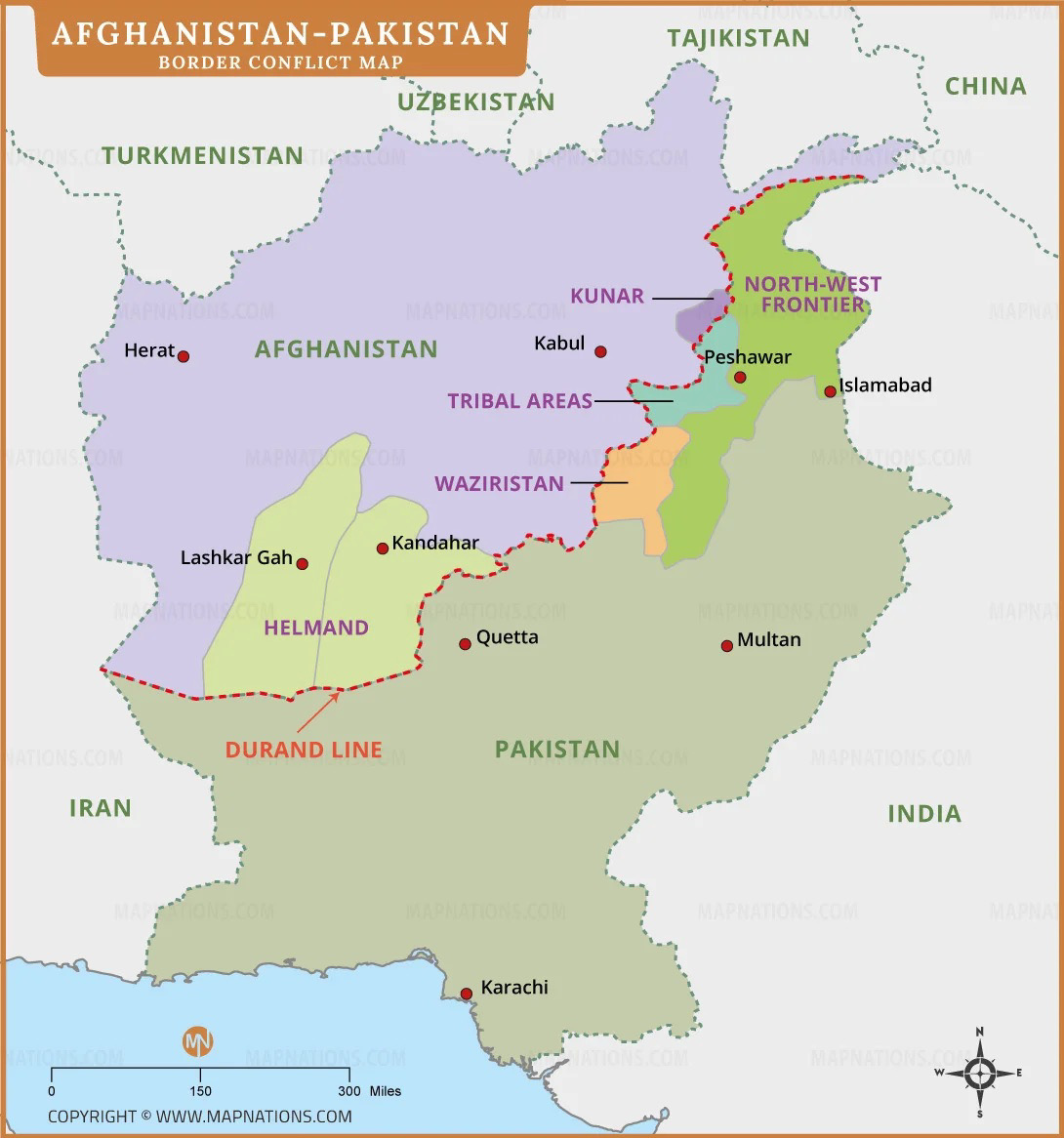
[Map of the Afghanistan–Pakistan border region]
Tehrik-e-Taliban Pakistan (TTP) and ISIS-K (also known as ISKP or IS-K) are jihadist groups active mainly in the Afghanistan–Pakistan borderlands. Both are designated terrorist organizations by the United Nations, the United States, and others. They share some historical roots and operate in overlapping terrain, yet differ in ideology, objectives, and relations with the Afghan Taliban.
The TTP
The TTP seeks to overthrow the Pakistani government and establish a strict Islamic emirate based on its interpretation of Sharia, beginning in the tribal and Pashtun areas. It opposes Pakistani military presence and past cooperation with the U.S.-led campaign against terrorism. Historically it has supported the Afghan Taliban. In practical terms, it aims to make Pakistan more closely resemble Taliban-ruled Afghanistan. The group has experienced a marked resurgence since the Taliban’s 2021 takeover and the U.S. withdrawal, with attacks rising in Khyber Pakhtunkhwa and Balochistan. Activity levels in 2025 already exceeded full-year 2024 figures in some trackers.
Pakistan accuses the Afghan Taliban of permitting TTP safe havens and operations from Afghan territory—the central driver of the 2026 border conflict. The Taliban generally denies the charge and has not cracked down to the degree Islamabad demands. The TTP has expressed sympathy or allegiance toward the Afghan Taliban while operating independently. Its methods include assassinations, ambushes, bombings, suicide attacks, and assaults on security forces, politicians, and sometimes civilians. High-profile operations inside Pakistan have targeted military bases, police, and government sites; the group also claimed a failed 2010 Times Square bombing plot. Estimates of its strength run as high as 6,000 fighters.
Fighting has continued intermittently for more than five months as of late July 2026, concentrated in eastern Afghan provinces (Kunar, Khost, Paktika, Paktia, Nangarhar) and adjacent Pakistani frontier areas. Notable incidents include Pakistani strikes (some reported to affect civilian sites, including claims involving a Kabul drug-rehabilitation facility earlier in the year) and Afghan retaliatory drone or airstrikes on alleged militant positions in Pakistan. Each side blames the other for incursions. Civilian casualties have been substantial. UN and other reports have cited hundreds of Afghan civilian deaths and injuries in the early phases, along with displacement peaking above 100,000 people. Casualty figures released by the parties themselves are incomplete and contested.
ISIS-K (Islamic State – Khorasan Province)
ISIS-K is the South and Central Asian province of the Islamic State. Formally announced in 2015, “Khorasan” refers to a historical region spanning parts of Afghanistan, Pakistan, Iran, and Central Asia. It formed largely from defectors, including TTP fighters, members of the Islamic Movement of Uzbekistan, and some former Afghan Taliban who rejected the Taliban’s more localized focus in favor of ISIS’s global caliphate vision.

[Khorasan Province – overlapping Iran-Afghanistan-Turkmenistan]
Its objective is a transnational Islamic caliphate under an extreme Salafi-jihadist reading of Sharia.
It regards the Afghan Taliban as illegitimate “apostates” or insufficiently pure because of the Taliban’s ties to al-Qaeda, willingness to negotiate, and concentration on Afghanistan rather than worldwide jihad. Targets include Shia Muslims, other minorities, the Taliban, Pakistani forces, and international sites. Leadership turnover has been high due to killings. UN assessments around 2025 placed its strength in Afghanistan near 2,000 fighters; recruitment draws from Central Asia and beyond. Tactics emphasize lethal suicide bombings, mass-casualty attacks, and targeted killings. Notable operations include the 2021 Kabul airport bombing during the U.S. withdrawal (killing scores of Afghans and 13 U.S. service members), attacks in Iran and Russia (including the 2024 Moscow concert-hall assault claimed by the group), strikes inside Pakistan and Afghanistan against civilians, minorities, and Taliban targets, and plots in Europe. The group maintains strong propaganda capabilities, including experimentation with AI-generated messaging.
ISIS-K remains resilient inside Afghanistan, where it conducts frequent claimed attacks, and poses external risks through recruitment, infiltration, and plotting. It maintains a low-intensity conflict with the Taliban government, which has mounted operations against it. Pakistan has also struck alleged ISIS-K sites. The group is one of ISIS’s more capable external branches.
In short, TTP and ISIS-K have competed for fighters and territory; some early TTP members defected to join or form ISIS-K. Both exploit the porous border. Pakistan cites both groups when justifying cross-border action against alleged sanctuaries in Afghanistan. The Afghan Taliban prioritizes suppressing ISIS-K as a direct rival while facing persistent accusations regarding the TTP.
These organizations contribute to regional instability: the TTP drives much of Pakistan’s domestic militancy problem, while ISIS-K remains a persistent transnational threat.
Historical Note
Determined to withdraw from Afghanistan regardless of the costs, ignoring the Doha agreement, despite pleas by the Afghan government and objections by our NATO allies, Biden proceeded unilaterally. Many contingencies were ignored, including a noncombatant emergency evacuation, creating an unsafe environment. Lethal threats and harm to US troops resulted in 13 deaths (Abbey Gate Terrorist Attack by ISIS-K – 8/26/2021. 13 US deaths, 45 wounded, 170 Afghan civilians dead). With Security degraded Afghanistan became a haven for terrorists anew. The Biden-Harris administration lied and misled the American people. A rapid Taliban takeover (2021) followed the decision under President Biden leading to a catastrophic withdrawal of American troops (approximately 2,500 at the end, down from a peak near 100,000). A report by the 2024 House Foreign Affairs Committee on the aftermath of the withdrawal called the decision “willful blindness.“ The action by this administration created additional threats to the United States. We abandoned the people we had promised to protect. Under the prior Ghani government the country was unstable and heavily aid-dependent; the Taliban already held significant rural influence and was advancing. Yet conditions for many Afghans—particularly regarding education and women’s participation—had improved relative to earlier periods of Taliban rule. U.S. forces provided advice, air support, intelligence, and logistics to the Afghan National Defense and Security Forces. After the withdrawal the ANDSF suffered rapid attrition and collapse. The subsequent imposition of the Taliban’s strictures has been largely uncontested and has reversed many of those earlier gains. The human cost continues. What is happening in Afghanistan today is a result of President Biden‘s actions.
Militant groups operating under banners of rigid political Islam are not primarily engaged in private religious practice. They are organized political actors seeking territorial or transnational control, justifying their campaigns by claiming divine sanction. Their frequent conflicts with one another underscore the political rather than purely theological nature of their projects. Such dynamics can produce or sustain Islamic-republic-style entities or competing factions. At present none of these groups possesses nuclear weapons; that remains a critical threshold not yet crossed. Where they gain footholds—whether in Afghanistan, Pakistan, or elsewhere—they seek to expand influence through the methods they have refined: intimidation, targeted violence, and the selective application of their legal codes. The majority of local populations typically reject their extreme agendas, yet numerical majority has often proved insufficient against organized armed minorities that control the means of coercion. Their stated objectives rarely center on building modern productive societies. (The Islamic Republic of Iran is an example of what can result)
Irony
Pakistan long supported the Afghan Taliban—during the 1990s and throughout the post-2001 insurgency—as an instrument of “strategic depth” against India and external influence in Afghanistan. After the 2021 U.S. withdrawal, expectations that the Taliban would act as a reliable partner and suppress anti-Pakistan groups proved misplaced. The relationship inverted into open hostility. From Pakistan’s standpoint the current campaign is a counter-terrorism effort against the TTP, a group that directly threatens the Pakistani State and that Islamabad believes is enabled—by neglect or design—from Afghan territory. The Afghan Taliban prioritizes its own internal cohesion and resists external demands that could fracture its ranks or appear as subordination to Pakistan. The TTP, for its part, seeks to transform Pakistan into an Islamic State of its own design. The result is a simmering, periodically intense border conflict driven by incompatible security priorities. Pakistan is determined not to lose control of its own territory or political identity.
by Thomas W. Balderston – Author and Blogger

