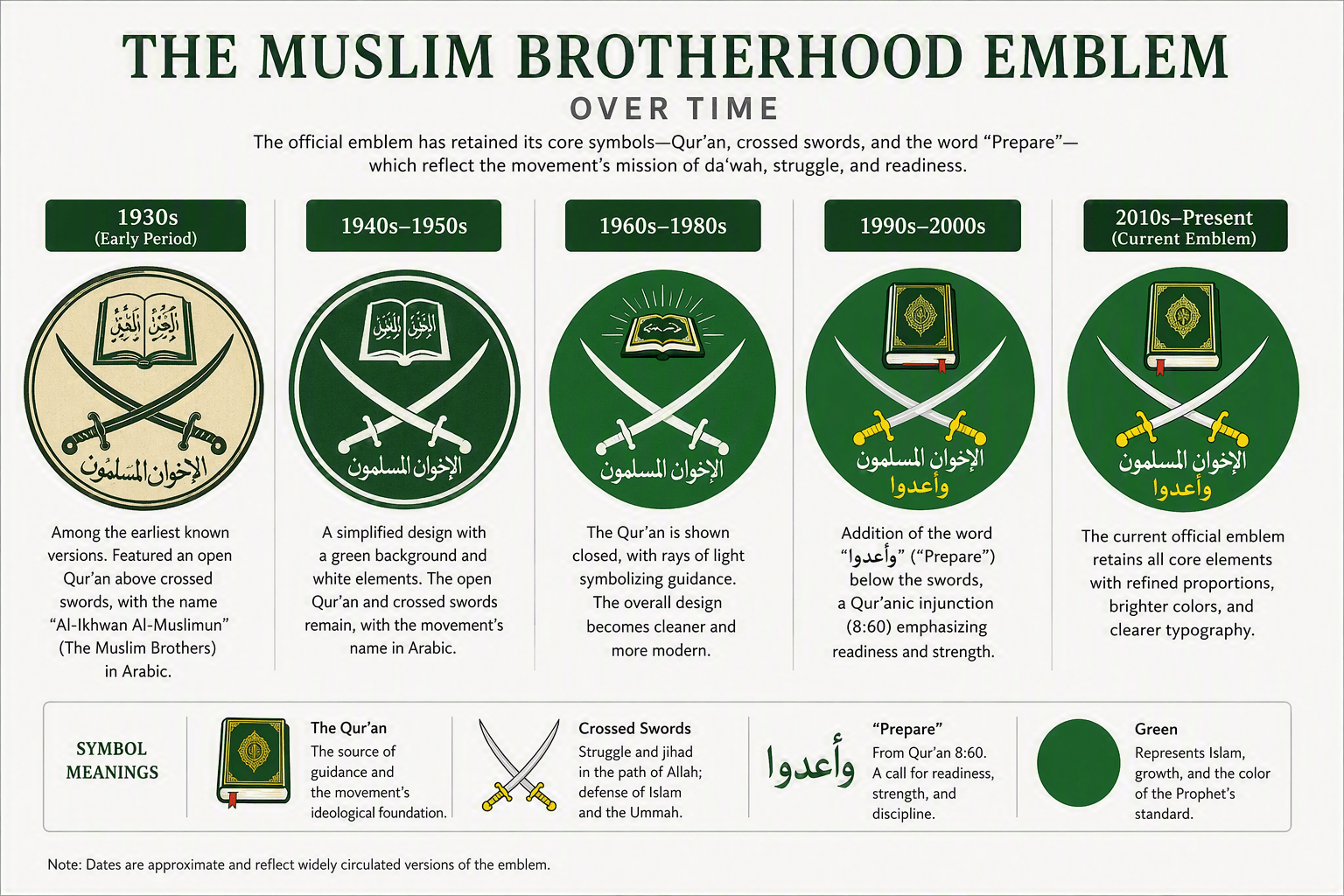
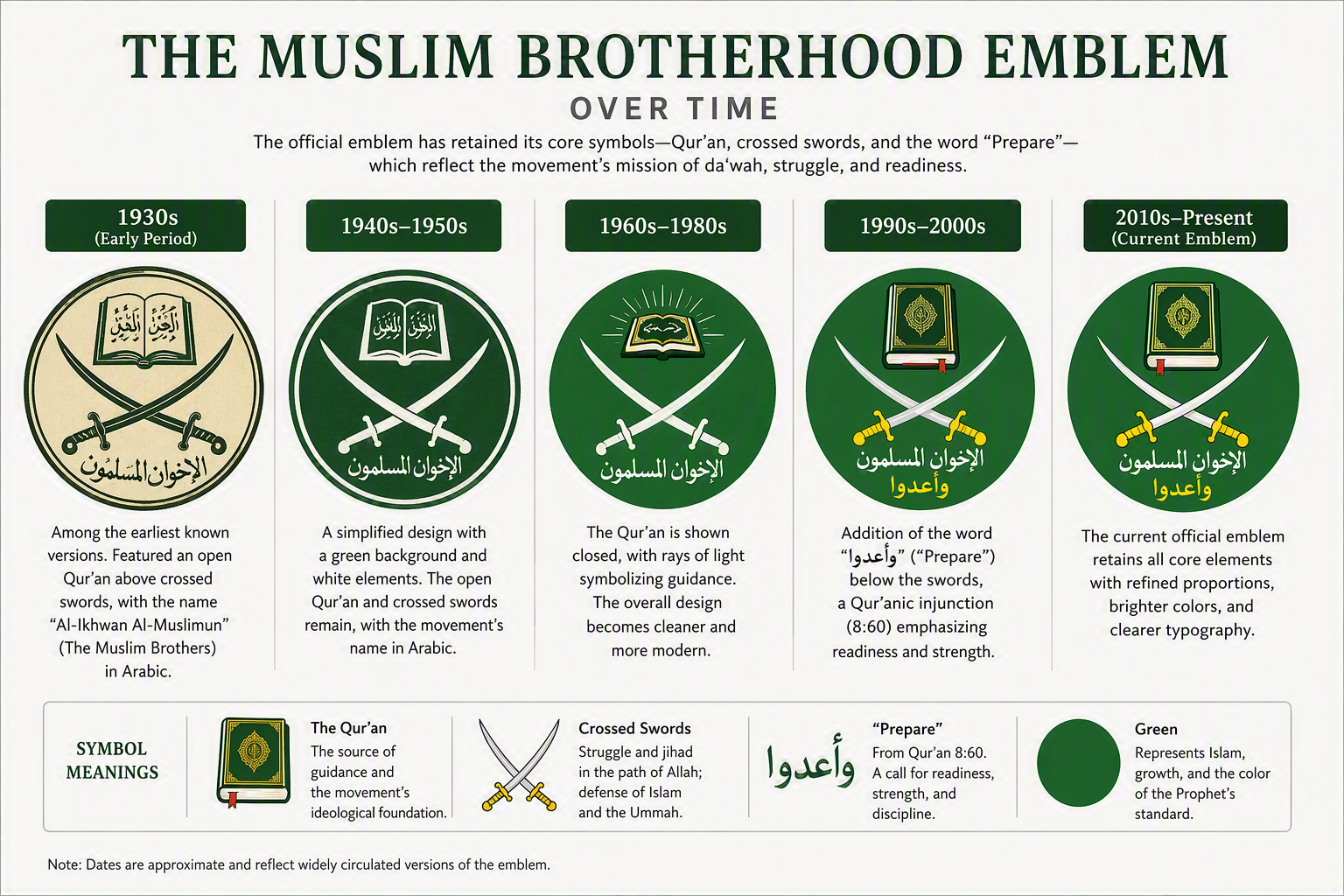
The Muslim Brotherhood, often called the MB or Ikhwan, began nearly a century ago with a clear idea: “Islam is the solution.” Founded in Egypt in 1928, it grew into one of the most influential Islamist movements of modern times. Its aim is not only religious revival but the creation of a global Islamic order under Sharia (Islamic law), ultimately restoring a Caliphate—a unified political and religious empire spanning much of the historic Muslim world.
For anyone following world events, politics, or questions of freedom and governance, the Brotherhood matters. Its ideas have shaped revolutions, political parties, violent groups, and quieter influence efforts in Western societies. Even when the organization looks weakened, its core ideology continues to challenge democratic freedoms, religious pluralism, and the separation of religion and state. This article outlines its beginnings, history, key figures and supporters, and the lasting concerns it raises.
The Foundation: A Response to the End of the Caliphate
The story starts in 1924. After World War I the Ottoman Empire collapsed. Mustafa Kemal Atatürk, founder of modern Turkey, abolished the Caliphate—the centuries-old symbol of Muslim political unity. He pushed Turkey toward secularism: separating mosque and state, emphasizing national identity over a pan-Islamic community (the Umma), and focusing on citizens’ needs rather than religious rule. These changes, known as the Six Arrows of Kemalism, upset many who viewed the Caliphate as essential to Islamic identity and destiny.
In 1928 Hassan al-Banna, an Egyptian schoolteacher and Islamic scholar, founded the Muslim Brotherhood in Ismailia, Egypt. He believed the answer to Muslim weakness and Western influence was a return to strict Islamic governance. The group’s slogan became “Islam is the solution.” Its credo declared: “Allah is our objective; the Quran is our constitution; the Prophet is our leader; Jihad is our way; and death for the sake of Allah is the highest aspiration.”
From the beginning the Brotherhood rejected the separation of religion and politics. It favored a theocracy in which Sharia would be the law everywhere. Secular democracy, free speech that criticizes Islam, gender mixing in many settings, and equal rights for non-Muslims without special taxes (jizya) had no place in its vision. The ultimate goal was a single Islamic super-state reclaiming what members saw as their historical destiny.
Growth and Ideology Through the 20th Century
The Brotherhood expanded through social work, education, and political organizing. It built mosques, schools, charities, and youth groups while promoting a strict reading of Islam. Thinkers such as Sayyid Qutb radicalized the message further. Qutb argued that most Muslim societies had fallen into a state of ignorance and that true believers must wage jihad—including violent struggle—to establish pure Islamic rule. His writings later inspired groups more extreme than the original Brotherhood.
The movement spread beyond Egypt. Affiliates and inspired parties appeared in Jordan, Algeria, Kuwait, Tunisia, Libya, Bahrain, and Iraq. In 1987 Hamas was founded in Gaza as the Palestinian branch of the Muslim Brotherhood, with the stated goal of destroying Israel and replacing it with an Islamic state. Hamas’s actions and ideology have consistently reflected Brotherhood thinking. Funding and support have come from various sources, including Brotherhood-linked networks and later significant backing from Iran and Qatar.
The group has never been purely peaceful. While some members focused on gradual political change through outreach (dawah), others endorsed or took part in violence. Brotherhood documents and leaders have repeatedly framed their mission in terms of jihad against perceived oppressors, including Western powers and Israel.
The Arab Spring Peak and Dramatic Fall
The Arab Spring uprisings that began in late 2010 gave the Brotherhood its greatest political chance. In Egypt, after Hosni Mubarak fell in 2011, the Brotherhood’s Freedom and Justice Party won elections. Mohamed Morsi, a Brotherhood leader, became Egypt’s first democratically elected president in 2012.
His year in power proved polarizing. Critics said the Brotherhood tried to monopolize power, impose Islamic rules, and sideline secular, liberal, and Christian voices. Massive protests followed. In July 2013 the Egyptian military under Abdel Fattah el-Sisi removed Morsi. A harsh crackdown ensued. Egypt banned the Brotherhood and designated it a terrorist organization. Thousands were imprisoned; many were killed. Supreme Guide Mohammed Badie received life sentences and remains in prison. Morsi died in custody in 2019.
Similar setbacks hit Brotherhood-linked parties elsewhere. The movement that had seemed ready for regional dominance was driven underground or into exile. Leadership split into competing camps, mainly in Turkey and London. By the mid-2020s the organization was weaker and more divided than in decades—yet still alive as an idea and a network of influence.
Major Players and Key Supporters
Several figures and countries stand out:
• Hassan al-Banna (founder, assassinated 1949): Built the organizational and ideological base.
• Sayyid Qutb: Radicalized the ideology; his books remain influential.
• Yusuf al-Qaradawi (died 2022): A leading intellectual who lived for decades in Qatar, justified suicide bombings against Israelis, and received a major platform on Al Jazeera.
• Mohamed Morsi: Egypt’s short-lived Brotherhood president.
• Mohammed Badie: Longtime Supreme Guide, now imprisoned.
• Hamas leaders: Explicitly part of the Brotherhood family and responsible for the October 7, 2023 attacks on Israel.
Qatar has been a major state backer. It hosted Brotherhood figures including al-Qaradawi, provided billions in support to the Morsi government, and used Al Jazeera to amplify Islamist narratives. Qatar continues to host Hamas political leaders and has channeled funds that strengthened the group’s capabilities.
Iran shares deep ideological roots with the Brotherhood despite Sunni-Shiite differences. Iranian revolutionaries, including the late Supreme Leader Ali Khamenei, studied and translated Qutb’s works. Iran has long supplied weapons, training, and money to Hamas. Ruhollah Khomeini founded the Islamic Republic after the 1979 revolution. Ali Khamenei served as Supreme Leader from 1989 until his death in early 2026 during the Iran war. His son Mojtaba Khamenei became the new Supreme Leader in March 2026. The regime’s ties to Brotherhood-inspired groups continue under the new leadership.
Turkey under President Recep Tayyip Erdoğan has been another crucial supporter. Erdoğan’s political roots lie in the Milli Görüş movement, which shared the Brotherhood’s vision of political Islam. After Morsi’s fall, Turkey became a major refuge for Brotherhood leaders and activists. Istanbul hosted media outlets, organizations, and exiles. Turkey has consistently backed Hamas with political, financial, and logistical support. Even as Ankara later pursued pragmatic ties with Egypt, Saudi Arabia, and the UAE, the underlying affinity remained, and support for Hamas continued.
At home, Erdoğan has pursued what many call neo-Ottomanism—a deliberate move away from Atatürk’s strict secular republic. He has expanded Islam’s role in public life, education, and politics, celebrated Ottoman history and symbols (including reconverting Hagia Sophia into a mosque), centralized power, and shifted foreign policy toward greater engagement with the Middle East and the wider Muslim world. Critics see this as a sustained effort to reverse key aspects of Atatürk’s secular reforms in favor of a more Islam-centered, historically Ottoman-inspired model of state and society.
In the United States and Europe the Brotherhood’s influence has been subtler. Starting in the 1960s, members and sympathizers helped create groups such as the Muslim Students Association, Islamic Society of North America, and later the Council on American-Islamic Relations (C.A.I.R.). A 2005 document known as the “General Strategic Goal for the Group in North America” described a long-term “Civilization-Jihadist Process”: building institutions, expanding an observant Muslim base, and working to undermine Western civilization from within so that Islam becomes dominant. Similar plans existed for Europe.
The Ongoing Concern
Why does a movement that is currently fragmented still raise serious concerns? The answer lies in its unchanging goals and methods.
The Muslim Brotherhood does not accept liberal democracy as a final system. It treats democracy as a temporary tool that can be used to gain power, after which Sharia must replace man-made laws. Freedom of religion, free speech that includes criticism of Islam, gender equality as understood in the West, and full equality for non-Muslims are not core values of the movement. Its own documents speak of a gradual cultural and political transformation aimed at establishing Islamic governance.
Affiliates such as Hamas have repeatedly used terrorism. In 2026 the United States designated the Egyptian, Jordanian, and Lebanese branches as terrorist organizations because of material support to Hamas and involvement in attacks. Saudi Arabia, the UAE, Egypt, Bahrain, and others had already done so. Turkey and Qatar continue to provide residual safe havens and soft-power amplification.
In Western countries the challenge is less about immediate violence and more about long-term influence: shaping education, campus activism, political lobbying, and public debate so that criticism of Islamist ideology is labeled bigotry while the ideology itself spreads. Networks linked to the Brotherhood continue to operate through charities, student groups, and advocacy organizations. Several European governments have issued warnings about institutional infiltration.
The movement’s patience is part of its strength. It plays a multi-generational game. Even when crushed in one country, the idea travels with people, media, and digital networks.
Why Awareness Matters
The Muslim Brotherhood is not every Muslim. Most Muslims worldwide are not members and many reject its political project. The danger comes from a specific ideology that seeks to replace free, pluralistic societies with a theocratic order based on a legal framework interpreted by modern activists.
Free societies survive when citizens understand ideologies that reject their core principles. Read primary sources. Compare the Brotherhood’s own statements with democratic values. Support open debate, free speech, and religious liberty for everyone. Demand that governments distinguish between peaceful practice of faith and political movements that use faith as a vehicle for domination.
History shows that totalitarian ideas—whether communist, fascist, or theocratic—rarely disappear after a setback. They adapt, go underground, and wait. The Muslim Brotherhood has done exactly that for nearly 100 years. Understanding its foundation, history, major players (including the roles of Qatar, Iran, and Turkey under Erdoğan), and goals is not about fear. It is about clear-eyed defense of the freedoms that make open discussion possible in the first place.
By Thomas Balderston, Author and Blogger
Note: Italics are my own, for emphasis.
 Wake Up! Wake Up!