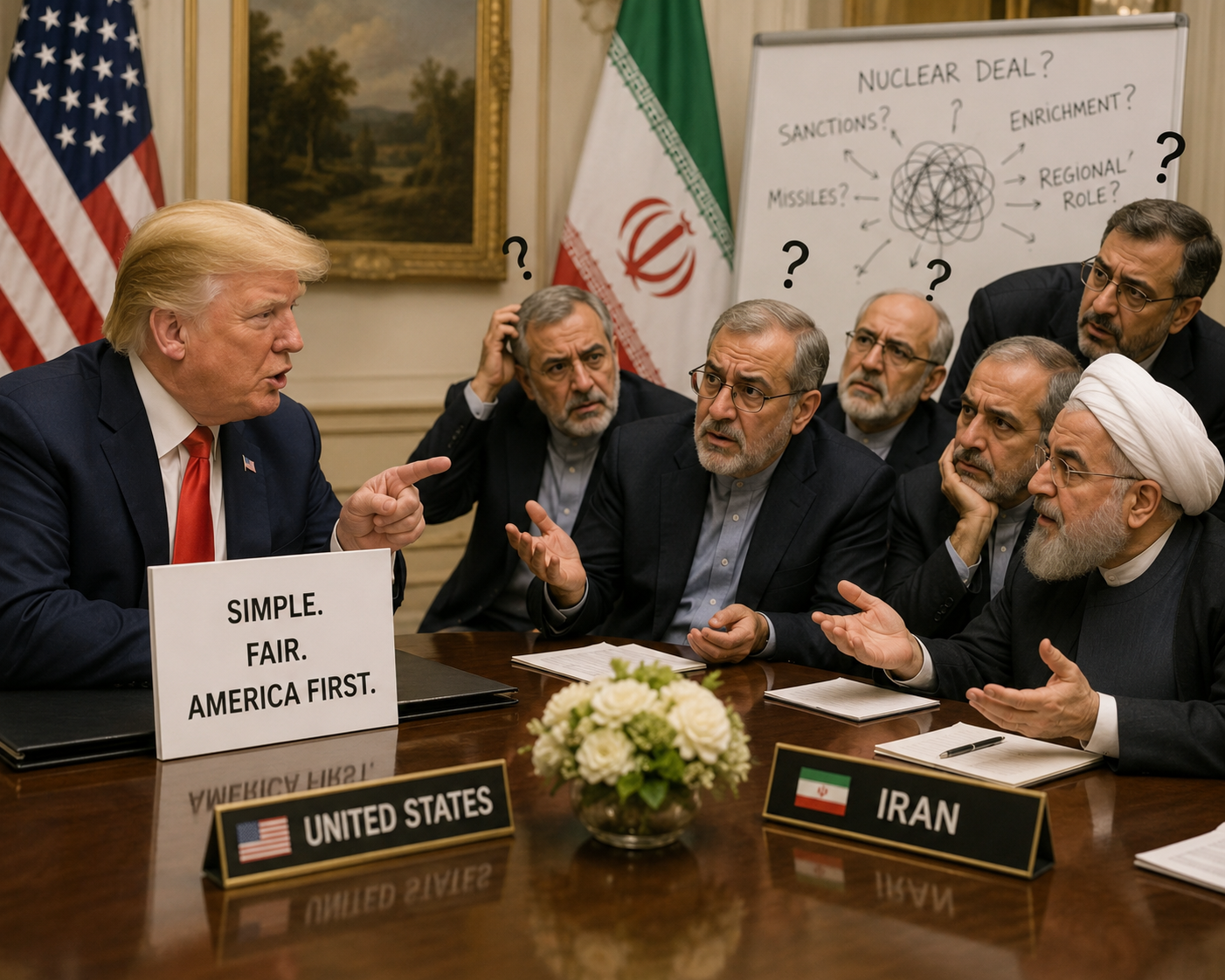
Operation Epic Fury has produced an uneasy 80-day ceasefire, yet a final agreement remains elusive. The core obstacle is not merely Iran’s nuclear program or leverage over the Strait of Hormuz. It is the regime itself—a complex, fragmented system of competing power centers where no single concession reliably binds the whole.
Why Agreements Are So Difficult
Iran’s government features deliberate redundancy and institutional rivalry. The Supreme Leader (currently the office held after Khamenei’s passing) holds ultimate authority under the constitution as vali-e faqih (Guardian Jurist), overseeing major policies, the military, judiciary, and media. The clerics and their religious institutions, primarily mosques, have the Ayatollah’s ear on matters of Shia jurisprudence, and aligning the Ayatollah’s decisions with his and their ideology. The Islamic Revolutionary Guard Corps (IRGC) operates as a powerful parallel military-economic force with its own business empire. The elected President and Majlis (Parliament) represent the political track, but candidates are heavily vetted by the Guardian Council. Clerical institutions, the regular army (Artesh), and bureaucratic elements add further layers. Factions within these centers often pursue competing interests, making unified decision-making cumbersome.
This structure is no accident. It reflects the Islamic Republic’s hybrid origins and ensures the revolution’s survival through checks and balances—often at the expense of decisive governance. The result resembles committee design (a camel when trying for a horse): outcomes are frequently suboptimal compromises.
Historical Context and Resilience
Iran (historically Persia) boasts one of the world’s oldest continuous civilizations, from the Achaemenid Empire under Cyrus the Great through successive rulers—including Alexander’s successors, the Sassanids, Arab Muslim conquests (7th century), Mongols, and others. Persian cultural and administrative identity endured, even as borders contracted to the Iranian plateau. Pre-1979 Iran under the Pahlavi Shah was a secular-leaning authoritarian monarchy with Shia Islam as the state religion, rapid modernization, and Western ties. It was not a full democracy; the Shah’s regime featured repression via SAVAK and limited political freedoms. The 1953 U.S./UK-backed coup against Prime Minister Mossadegh amid oil and Cold War concerns that restored the Shah to the throne is a reminder of the sway Americans held over the nation for decades. .
The 1979 Revolution under Ayatollah Khomeini marked a sharp break, establishing an Islamic theocracy where religious matters holds primacy. Islam’s influence grew gradually after the 7th-century conquests, but full clerical dominance is a modern phenomenon.
Ideology, Pragmatism, and Martyrdom
Iranian leaders blend revolutionary Shia ideology—emphasizing resistance, martyrdom, and divine favor (echoing early Islamic victories like Badr)—with pragmatic survival instincts. Martyrdom rhetoric is potent, especially among hardliners, and shapes risk calculations. Yet history shows restraint under pressure: Khomeini famously “drank the poisoned chalice” to accept UN Resolution 598 and the 1988 ceasefire after the devastating Iran-Iraq War (1980–88), driven by exhaustion (after 8 tumultuous years), economic collapse, Iraqi advances, and fears of escalation (including the USS Vincennes incident).
The regime prioritizes system survival over rapid prosperity. Nuclear ambiguity and IRGC control of Gulf leverage serve as deterrents rooted in genuine distrust—stemming from 1953, the Iraq invasion (with Western backing for Saddam), and isolation. However, leaders are not purely irrational zealots; they respond to costs. They also dwell on personal interests and their foreign bank accounts.
The 2015 JCPOA temporarily constrained enrichment, reduced stockpiles, and extended breakout time in exchange for sanctions relief—demonstrating deals are possible when pressure aligns incentives, even if imperfect and reversible after the U.S. withdrawal in 2018.
For outsiders, negotiations focus on verifiable limits and preventing proliferation or regional chaos. For the regime, endurance itself equals success in a perceived existential religious and national struggle.
Key Issues
- Strait of Hormuz/IRGC: Economic lifeline and power tool; relinquishing leverage is painful.
- Nuclear Program: Viewed as insurance against regime change or invasion. A weaponized Iran would be unacceptable given ideology and hostility toward Israel (“Little Satan”) and the U.S. (“Great Satan”).
- Alignment: Securing buy-in across factions, especially the Supreme Leader’s religious red lines and IRGC interests, is extraordinarily hard. Signatures carry uncertain weight without broad internal consensus.
- Forgotten, or what about? Ballistic missile program, support for terrorism, proxy warfare and proxies, and human rights abuses.
The Regime Change Option—and Its Prospects
Without deeper structural change, the Islamic Republic is likely to persist, reconstitute under sanctions, enrich hardliners, and pursue regional hegemony through its “Axis of Resistance.” A shift toward a more secular, pragmatic “Persia” — restoring reasonable governance rooted in Iran’s national identity — could fundamentally transform prospects for stability, prosperity, and productive international relations.
Reminiscent of the movie Terminator 2, where Arnold Schwarzenegger battled the more sophisticated liquid metal T-1000 Terminator. No amount of destructive force against this machine could prevent it from being reconstituted and continuing to seek the death of John Conners. The machine is like Islam. When this enemy is not totally sidelined it makes a return. So we have experienced with Hamas, Hizbollah, and Afghanistan. Somehow these battles rage on, delayed on occasion, but the ashes are left, often provided aid, rekindle the fight and cause a need to attack anew, more lives lost, and the religious war never ending. Appeasement is no answer, for even when under President Clinton Palestine was offered a two State solution, they refused, wanting only the death of Israel.
History strongly supports the feasibility of such a transition (the Persian remnants able to handle administrative functions) with greater continuity than many assume. Iran’s administrative core and Persian cultural identity have repeatedly survived conquests, dynastic changes, and foreign occupations for over two millennia. From the Arab Muslim conquests and Mongol invasions to the establishment of the Safavids and the relatively orderly Pahlavi transition in 1925, Persian bureaucracy, institutions, and national cohesion have often absorbed shocks and enabled new rulers to govern effectively. A post-theocratic Iran could similarly draw on its professional civil service, Artesh military professionals, educated population, and deep national identity to maintain stability, avoiding the total collapse scenarios sometimes feared.
Note: it was in 1935 that Reza Shah changed the name from Persia to Iran. Among all the changes in the Islamic world after WWI, when the Ottoman Empire was disassembled, only the borders of Persia were consistent with the culture and history of the area. And it remained Persian, not Arab.
That said, modern pitfalls remain real and must be acknowledged. The Islamic Republic’s parallel institutions (especially the IRGC’s ideological-economic empire), ethnic diversity, and revolutionary entrenchment could produce short-term friction, elite infighting, or localized unrest during any transition — particularly if externally imposed rather than internally driven. Risks of temporary power vacuums, refugee flows, or proxy disruptions cannot be dismissed, even if full-scale fragmentation is unlikely given Iran’s historical resilience.
The least chaotic path is therefore facilitated internal evolution: sustained external pressure to encourage defections, empower pragmatic nationalists and reformists, and support organic popular movements (such as the “Woman, Life, Freedom” protests). Arming the resistance would help as current efforts are met by the Basij oversight rabid watchdogs. With patience and smart leverage, Iran’s legendary adaptability could once again produce a more stable, secular governance that preserves Persian continuity while shedding theocratic rigidity.
A Realistic Path Forward
Effective policy blends containment with leverage: sustained sanctions, naval deterrence in the Gulf, strengthened alliances with Israel and Arab partners, and any nuclear agreement backed by intrusive verification and snapback sanctions. Quiet support for Iranian civil society, information access, and credible alternatives to the current regime should accompany this approach — without overt military occupation or nation-building.
Model Iran as the hybrid actor it is: ideologically driven yet responsive to costs, incentives, and its own survival imperative. Pure rationality assumptions will fail, but so will dismissing all pragmatism in Tehran.
Trump is being pragmatic. His approach is “peace through strength,” using force to improve his leverage. It is messy, inconsistent in what he is telling the public, and to some extent he appears stumped by Iran’s structural realities. He is not dealing with a counterpart. U.S. interests are being prioritized. Regime change at this moment may be a fantasy. No troops on the ground is the plan, and neither is transformation, just no nukes, open the Strait and avoid getting bogged down for an indeterminate period.
Iran’s resilience is legendary. Diplomacy must account for its fractured power structure, ideological drivers, and proven capacity for institutional continuity. Absent fundamental reform, durable agreements will remain elusive — but targeted pressure, combined with openness to a post-theocratic Persia, offers the best chance to shape a better outcome.
Grace and Peace
 Wake Up! Wake Up!
A good one! Best, Jim
LikeLike