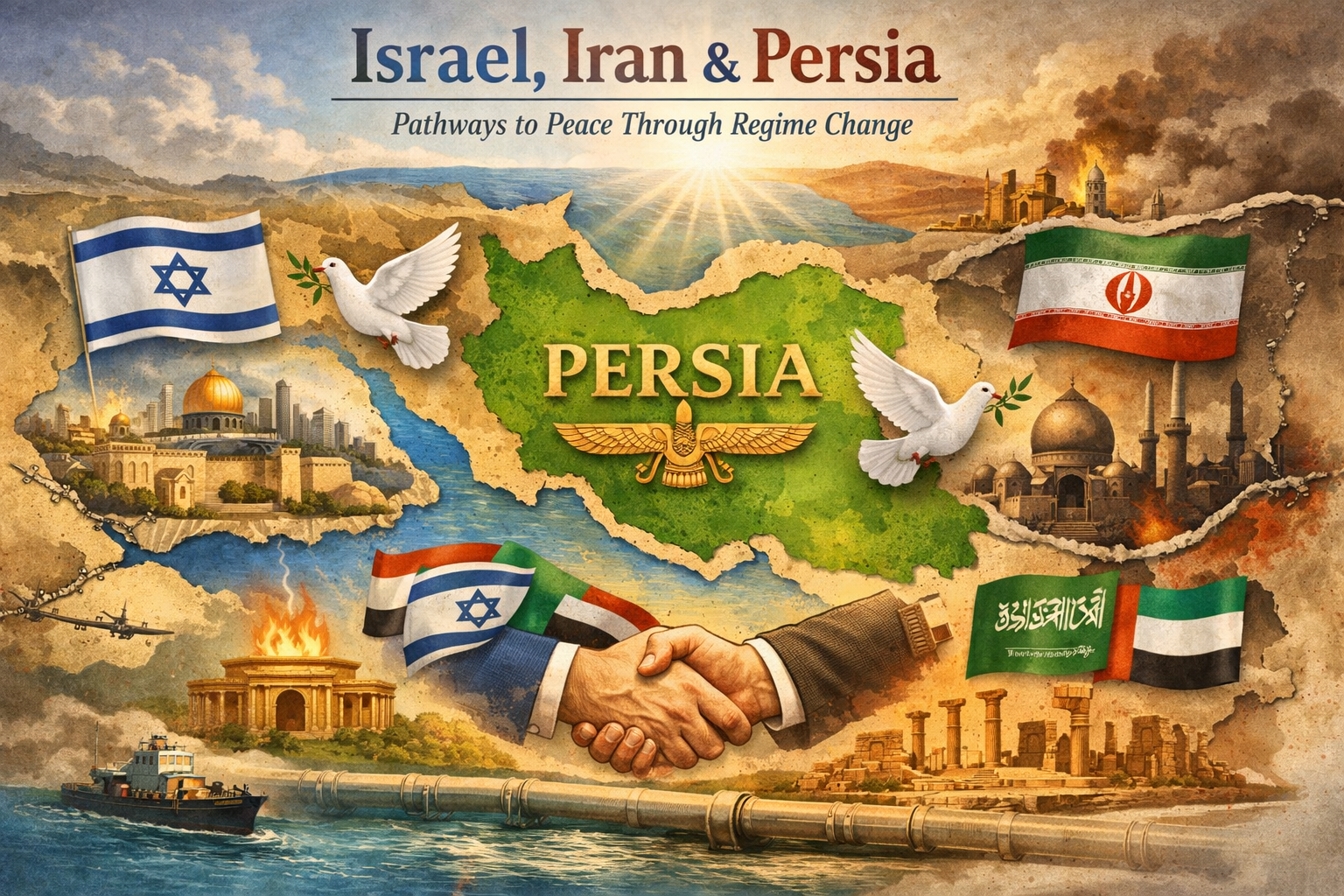
Israel and Iran
Since the early 1990s, Israeli leaders have warned that Iran’s clerical regime harbors an obsessive desire to destroy the Jewish state. They portrayed the leadership as irrational actors driven by suicidal ideological fervor, largely immune to conventional deterrence. With Iraq defeated in the 1991 Gulf War—a former common adversary that had once fostered tacit cooperation between Israel and Iran—Jerusalem turned to Western partners for support against what it viewed as an unpredictable theocracy armed with nuclear ambitions.
The 1979 Iranian Revolution marked a profound rupture. Before the Revolution, under the Shah (Pahlavi), Iran pursued ambitious modernization, aspiring to global prominence on par with Japan or the West. His vision emphasized capitalism, technology, and strong ties with the United States and Israel. Yet corruption and authoritarian tendencies alienated many, enabling Ayatollah Khomeini to harness mosque networks and spark a successful popular uprising. What had been a pro-Western power with suzerainty ambitions in the Persian Gulf became a Shia Islamic Republic, positioning itself as the vanguard of global Islamic revolution and a sworn enemy of the West and Israel—the region’s sole democracy at the time.
The “Mad Mullah”
The Ayatollah was labeled the “mad mullah” then, and his successors followed a similar path. Today, the picture is even more fragmented: coupled with the ailing Supreme Leader and his influential inner circle, an emboldened and enriched IRGC alongside competing political factions create a hydra-like structure, often pulling in conflicting directions with no clear vision for Iran’s future.
The successor Mullah (Ayatollah) Mojtaba Khameini may have left the building. News reports (unverified from Saudi sources) on July 19, 2026, Fox News and other sources, that Mojtaba is not in Iran. He is probably wherever he or his dad moved as much money as possible. Could be Russia. There are also multiple reports of IRGC (Islamic Revolutionary Guard Corps) and Quds Force members (including lower-to-mid-ranking officers, personnel, and some commanders) defecting, deserting, or fleeing Iran in recent years, especially amid 2025–2026 conflicts with Israel and the US, protests, and internal instability. I expect more to follow to enjoy the largesse they stole and banked off shore. This may be a fissure in the wall of resistance to regime change. My concern about Mojtaba, if the reports are factual, is that he will use the mosque network to conduct a continuing campaign pushing his theological agenda and hate for Israel and America, as did the Khomeini when in exile.
The Islamic Republic prioritizes ideological purity and regional dominance over the well-being of its people. It seeks Shia-led hegemony across the Muslim world, yet it has struggled to rally the broader ummah—largely Sunni—to its banner. Many Arab states and Muslim societies view Iran’s heavy-handed clerical rule, Sharia enforcement, and proxy warfare as alien and destabilizing. This isolation from its Muslim neighbors to the west, including Saudi Arabia, helps explain Iran’s vigorous embrace of Palestinian grievances.
Beyond undermining Israel, Tehran has used the Palestinian cause to pressure Arab governments that pursued accommodation with the Jewish state, such as through the Oslo process in the 1990s. Support for a separate Israeli state was anathema to the Islamic Republic. Tehran framed its campaign not as geopolitics but as a sacred struggle for justice and Islamic honor. In 2004, Jordan’s King Abdullah II famously warned of a “Shia Crescent”—an arc of Iranian influence stretching through Iraq, Syria, and Lebanon—that threatened Sunni Arab stability. In 2006, Israeli Prime Minister Ehud Olmert described Iran as “a dark and gathering storm casting its shadow over the world.”
During the same period, the Bush administration expressed deep concerns over Iran as a hub of terrorism with nuclear designs, while Israel openly discussed potential strikes to halt the threat. Yet even amid these tensions, cultural affinities endured. Israelis continued to embrace Persian music, poetry, and heritage, recognizing deeper commonalities between Persian and Jewish civilizations than with the revolutionary regime. Iranian leaders, for their part, sometimes viewed Arab neighbors as less refined compared to Persia’s ancient civilized legacy—an attitude that further alienated Sunni Gulf states like Saudi Arabia, the UAE, and others.
The historical intertwining of Persian and Jewish destinies is profound. Cyrus the Great liberated Jews from Babylonian captivity and supported the reconstruction of the Temple in Jerusalem. Jewish communities thrived in Persia for millennia. Zoroastrian monotheism and ethical concepts influenced Jewish thought during the Achaemenid period. Today, thousands of Iranian Jews live in Israel, many with fond memories of their homeland and a desire for better relations under different circumstances. Some even suggest that life might feel simpler in a depoliticized Iran.
Recent Developments Offer Genuine Grounds for Optimism
The Abraham Accords demonstrated that normalization with Israel is possible when shared threats outweigh ideological divides. As Iran’s proxy network—the “Axis of Resistance” (Hezbollah, Hamas, Palestinian Islamic Jihad, Houthis, and various Iraqi/Syrian militias)—has been significantly degraded through conflict, and with direct pressures mounting on the regime itself, new possibilities emerge. Sunni neighbors increasingly see Israel as a partner rather than a threat, united by a common adversary.
Even the Houthis in Yemen, a notable outlier to the original Shia Crescent and a more autonomous member of the Axis of Resistance, would likely diminish as a regional threat. Deeply rooted in local Yemeni grievances, they could persist as a domestic actor but would struggle to project power far beyond their borders without sustained Iranian weapons, funding, and coordination.
A fundamental regime change in Iran could transform the region. If the Islamic Republic gives way to a more secular government that revives Persia’s rich cultural and intellectual heritage—one that respects individual choice in faith, draws on its pre-Islamic Zoroastrian roots, and prioritizes national prosperity over ideological export—the Middle East could enter a new era of moderation and cooperation. Persians have preserved their language, traditions, and connection to Zoroastrian heritage despite Islamization in the 7th century. Nowruz, celebrated for over 3,000 years, embodies this enduring soul.
The Thesis is Clear
Replacing the Islamic Republic with a secular, culturally confident Persian government would dramatically enhance prospects for peace across the Middle East. The Abraham Accords have already built bridges with Sunni neighbors. Recent conflicts have forged further alignment against a common threat. In such a transformed environment, practical steps like reopening the Eilat-Ashkelon pipeline—once a vital conduit for Iranian oil to Europe before 1979—could resume, fostering economic integration and mutual benefit.
This vision is not naïve but rooted in history, culture, and current realities. While regime change is not necessarily the immediate goal of every external actor (it is not currently President Trump’s stated priority, though it aligns closely with Israel’s long-term security interests), it holds immense promise for the entire region. A reborn, moderate Iran—reclaiming its identity as Persia—could become an intellectual and economic powerhouse, contributing to stability rather than upheaval and allowing ancient friendships to flourish once more.
Peace
For the first time in generations, this scenario could genuinely give peace a chance in the Middle East: no proxies serving an entrenched regime, normalized trade and acceptance with Arab Muslim neighbors, and reduced external pressure forcing a rigid two-state solution with the Palestinians. The pieces are aligning—if Iran’s people and leadership seize the opportunity.
 Wake Up! Wake Up!