Houthi’s
The Houthis have emerged as Tehran’s most capable and strategically important non-state partner, particularly in the Red Sea and the Horn of Africa. At the southern mouth to The Red Sea is the Bab el-Mandeb Strait, even narrower than the Strait of Hormuz. It can become a second choke point for Iran, controlled by the proxy, Houthi’s.
The Bab el-Mandeb Strait, which connects the Red Sea with the Gulf of Aden, is one of the world’s busiest maritime areas. Nearly 15% of global seaborne trade passes through this choke point each year, making it critical for commercial shipping and energy supplies moving between Asia and Europe.
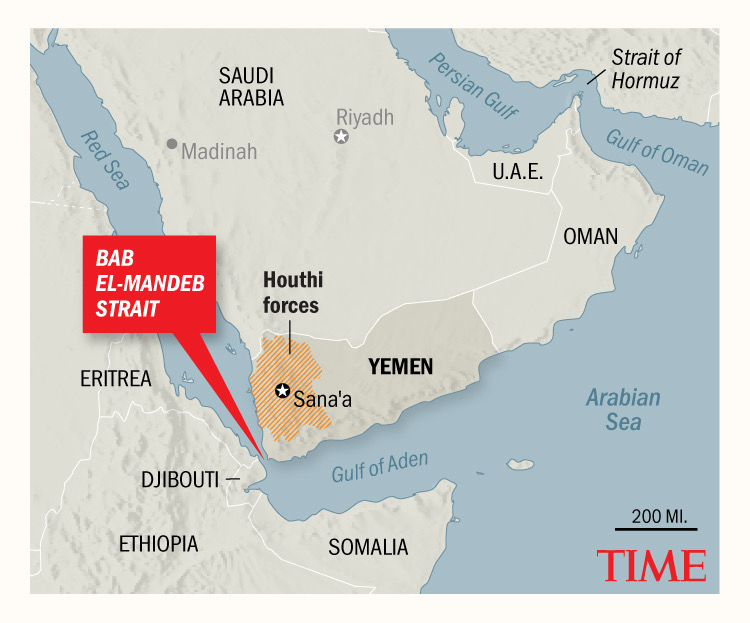
The Shia Crescent
When Iran exerted significant influence in Syria, under Bashem Al-Assad, they formed an arc of influence from Iran through Iraq, Syria, and Lebanon, and then below Israel, into Yemen. They were all Shia-Iran proxies. This Shia Crescent, controlled by an entity that declared death to Israel, was a concern to Israel. But it is also a concern to Sunni Islam, and the dominant voice of the largest followers of Islam, Saudi Arabia. From an Islamic perspective, viewed as battlelines being drawn between the largest powers to control the voice of Islam. One is Shia, and we know under the leadership of the Islamic Republic, promoting a revolutionary Shia Islamist political model, their focus to use force, and terrorist, gorilla warfare, to destabilize regions and take control. That is how they established the proxies in the first place. The other is Sunni with Saudi Arabia, the caretaker, custodian, of Mecca, the heart of Islam, where all Muslims once in their lives are to make pilgrimage (Hajj) to the Kaaba – “The House of Allah.” Also Medina. Saudi Arabia, as seen by the Sunni world, is the nation that has the military strength to defend its leadership role. Will Iran, and it’s Ayatollah, or Saudi Arabia, and it’s crown Prince, be the hegemony of the international order of Islam?

Houthi Origins
The Houthi’s were not created by Iran. They were a Shia Islamic sect (Zaydis) in Yemen dating back centuries. In the 90’s, led by Hussein Badreddin al-Houthi, his “Believing Youth” (al-Shabab al-Mu’min), a resistance movement began against proselytization by Salafi’s (a puritanical Sunni sect). Houthi also felt his faction was being marginalized by what he considered a corrupt Yemen government, at the time led by President Ali Abdullah Saleh. As history has demonstrated when factions of Islam differ, they go about attempts at settling these differences in violent, belligerent, and militant ways. The Yemeni government was weak, at that time, and did little too curb the rising tensions between the competing ideologues. Houthi was killed by Yemeni military in 2004. The aftermath was just more chaos, the Saada Wars, lasting many years (roughly 2004 – 2010). This was a local fight with central government leadership and northern Zaidi opposition groups.
By 2009 Iran saw an opportunity, even though the Shia of Houthi’s, and the Twelver Iranians, did not fully align. For Iran it represented an opportunity to support a group that shared a dislike for Israel, Saudi Arabia, and the United States and could be further developed to fight these adversaries. Having borders with Israel and Saudi Arabia gave Iran proximity for insurgent attacks on their declared enemy. Tehran began providing weapons (missiles, drones), technical support, training, and financial aide; the Houthis became a stronger more adept asymmetric fighting force. They began attacking ships in the Red Sea and Israel. The Houthi’s supported Hamas during the Gaza conflict, and remain in solidarity with the Palestinians.
An Aside
What I always find about Islamic centers of power is their aggressive actions towards those they hate, justifying their hate as being directed by god, or Allah. Reading and interpreting the Quran literally they find their destiny is killing Jews, and killing those who attempt to influence, modernize, or alter the basic tenets of Islam, as their sect interprets the foundational elements. Dying fighting for the All-for-Allah objective of Islam is more worthy, with greater afterlife rewards, than a normal death. They claim they are not aggressive, and their actions result due to aggressive actions towards them, call it “Islamophobia.” If Islam is simply not accepted, then those that deny Islam are the aggressor, and as a result, the Islamist can defend themselves. In all my reading, from a historical perspective, and from worldwide terrorist actions, predominantly by Islamists, and what you hear and read throughout the world from the media, Islam is the aggressor. They will kill your dog because they do not like dogs.
The Straits
The Strait of Hormuz is strategic for Iran as they see by controlling this international waterway they can garner resistance from world powers to attacks on their Regime in order to maintain essential needed supplies sourced from Persian/Arabia Gulf neighbors. They believe also that the Ban al-Mandeb Strait can do the same. Having to re-route around Africa (Cape of Good Hope) is costly to shipping. Controlling these two Straits could serve Iran by finding new partnerships to resist the Israel and the United States’ onslaught. It has not happen as yet, but the Islamists are in denial and will, so it appears, resist, continuing to attack to their death, if that is what is required.
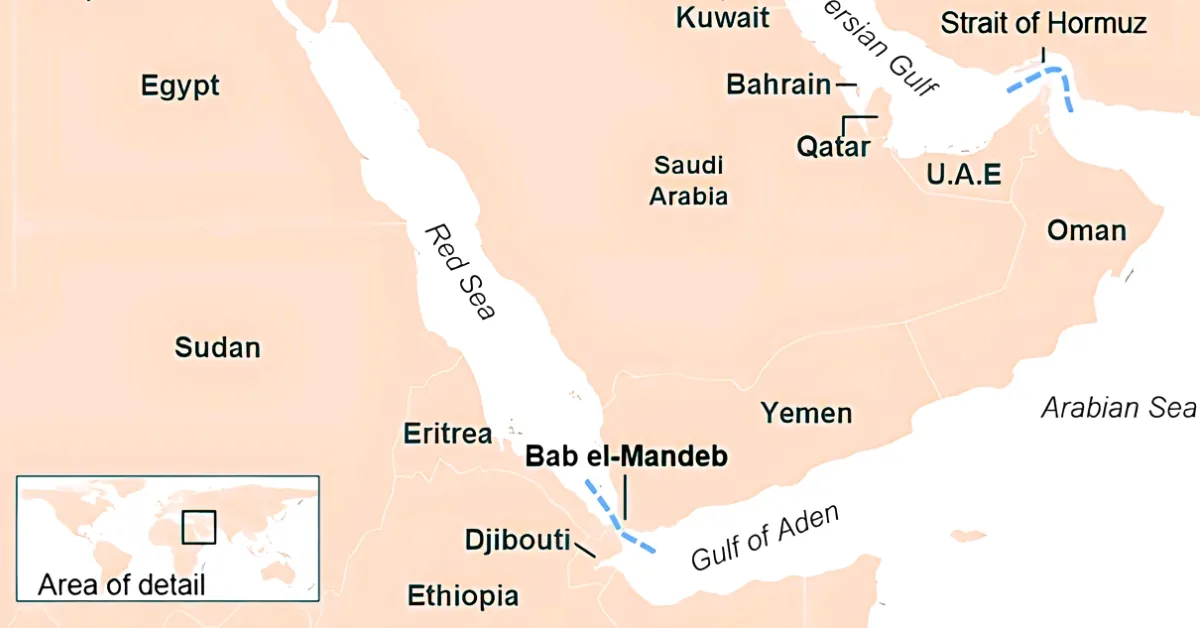
Axis of Resistance
The “Axis of Resistance” has been weakened, starting with Iran, with the fall of Assad (Syria), the diminished Hamas forces and launching sites in Gaza, and the reduction of Hezbollah forces, their political influence and a Lebanese government that seems more willing to resist. Attacks on the Houthi militants has been less obvious, but it is taking place. The Houthi’s maintain their autonomy and ability to disrupt Red Sea traffic. The U.S. has occupied areas on the opposing shore of the Bab al-Mandeb Strait. Djibouti (Camp Lemonnier) is a key hub for U.S. regional operations. There has also been interest in access and potential basing operations in Somaliland to diversify positioning near the Mandeb Strait. Whereas with Oman on the opposing point of Hormuz, the U.S. unable to have troops on the ground, naval support is essential as both blockade and protector for freedom of passage of acceptable shipping.
Ideology, Power and Extremism
It is not just the religion of Islam, it is the politics, the geopolitics, of Islam driven by power competition in the region that is in play. The theological aspect is questionable, as I feel Islam is not a religion. I say again, Islam is “not a Religion,” it is a political ideology guided by its own Alinsky playbook, the Quran, and hiding behind how many define “Religion,” using Religion as a burka covers a woman. You really do not know what is underneath. It could be a man. But what Islam is hiding is the fact it is an ideology, a political movement seeking world domination, and the Sunni and Shia head butting is over who comes out on top. Iran‘s approach has emphasized, asymmetric warfare, proxies, and revolutionary ideology. Saudi Arabia projects conventional military strength, and custodianship of the holy sites.
Broader Claims
The majority of the world’s approximately 2 billion Muslims are moderates, they accept a more liberal and modern day interpretation of the Quran mitigating some of the extreme elements. Moderate Muslims often seek peaceful coexistence, integration where they live, and contextual readings of scripture that downplay or reinterpret verses from the Medinan period (e.g., Surahs 8 and 9) as tied to specific 7th-century conflicts rather than timeless commands. In contrast, many institutional preachers and scholars — especially in networks influenced by Salafi/Wahhabi funding or Iranian revolutionary ideology — teach stricter adherence to classical Sharia, portray moderates as compromised or insufficiently faithful, discourage full assimilation into non-Islamic societies, and frame resistance or jihad (not just in its militant sense, but also thru migration and politics) as a religious duty. Moderates reject violence and extremism. But to the fundamentalist, the Sunni Salafi and Wahabbi’s, and the Shites (the revolutionary Twelver Shia Theology) the moderates are wrong, and they are as much of an infidel as the Jew and Christian and other non-believers, deserving of the wrath of their scripture and the Sharia. To his Shia adherents the Ayatollah justifies aggressive actions, including terrorism and insurgency against perceived enemies (Israel, the West, and sometimes fellow Muslims who are insufficiently orthodox),
Extremist groups and individuals have carried out the majority of Global terrorist attacks in recent decades in the name of Islam ideology. The proxies of Iran have been a larger force of extremism. There is a legitimate security concern shared across the world, including by moderate Muslims, who are often targets themselves, of the horrendous activities and designs of the fundamentalist extremists. Pockets of these groups in Europe, United Kingdom, and the United States, and bearded individuals with raised fists and clenched teeth, their thobes less than pure white, are constantly claiming that Islam will dominate the world and their respective countries. They do this with vicious overtones. And you wonder why Muslims cry out that they are being maligned because of Islamophobia. Such cries are just an excuse for them to be aggressive towards the infidel.
Sharia
Sharia refers to Islamic law and ethical guidance derived primarily from the Quran and the Hadith (recorded sayings and actions of the Prophet Muhammad), supplemented by scholarly consensus and analogical reasoning. It addresses personal conduct, family matters, criminal justice, finance, governance, and more. The Sharia is the Global law of Islam, it’s Constitution, and Muslim’s should live their lives, be obedient to the tenets of this ideology, obey, let Muhammad be the example, be a jihadist, militant or otherwise, for the cause, and honor the dictates of Allah as written. They are to do so in their communities, their states, their countries and in their daily lives. To do otherwise is to be a blasphemer.
The Tone in Mosques and Madrassas
For the moderates it is unfortunate as in the mosque network, and where this network is being expanded, the voices from the lecterns and pulpits, the scholars of Islam, are instructing their constituents to not assimilate, to be political, and to be unified in doing as needed for the All-for-Allah universal objective. The usual tone of leadership, teaching, and preaching is a significant issue worldwide. These voices frequently align more closely with fundamentalist interpretations than with moderate thinking.
The disconnect: while the overwhelming majority of individual Muslims are moderate and peaceful, the dominant institutional messaging in many religious institutions promotes a more fundamentalist worldview. This can foster parallel societies, resistance to Western norms, and in extreme cases, justification for violence against those seen as enemies of Islam (including Jews, Christians, secular Muslims, and “apostates”).
Proxies
The Houthi’s are another proxy for Iran. They use asymmetric means to advance regional goals, framed in religious and anti-imperialist terms. Their continued capability to threaten maritime traffic and protect power remains of concern for global shipping, Israel, Saudi Arabia, and the United States, even as the broader Axis has been weakened. Any proxy for Iran seeking to foment terrorism in those places they consider adverse, resistant and saying “no” to Islam is a concern. Funding and support of any kind from Iran is both a warning and a clear indicator of where actions need to be taken to curb developing attacks in the name of Allah, that being the case wherever you hear, Allahu Akbar.
Conclusion
My current thinking is the Mandeb Strait will remain open, at least in the near term due to strong deterrence, and the high costs of escalation. The situation remains fluid, driven by the interplay of religious zealots, ideology, raw geopolitical power competing in one of the world‘s most critical maritime corridors. However, Iran will try to use their non-state actor in Yemen to throw some missiles and drones at Saudi Arabia, Israel and ships at sea until thwarted back to reality. It will not be just the U.S. curbing the efforts of the Houthi’s; it will be the Saudi’s and Israeli’s too.
Meanwhile alternatives to shipping through Hormuz or Mandeb are proceeding, as pipelines to Mediterranean Sea ports.
by Thomas W. Balderston, Author and Blogger
 Wake Up! Wake Up!