by Thomas Balderston
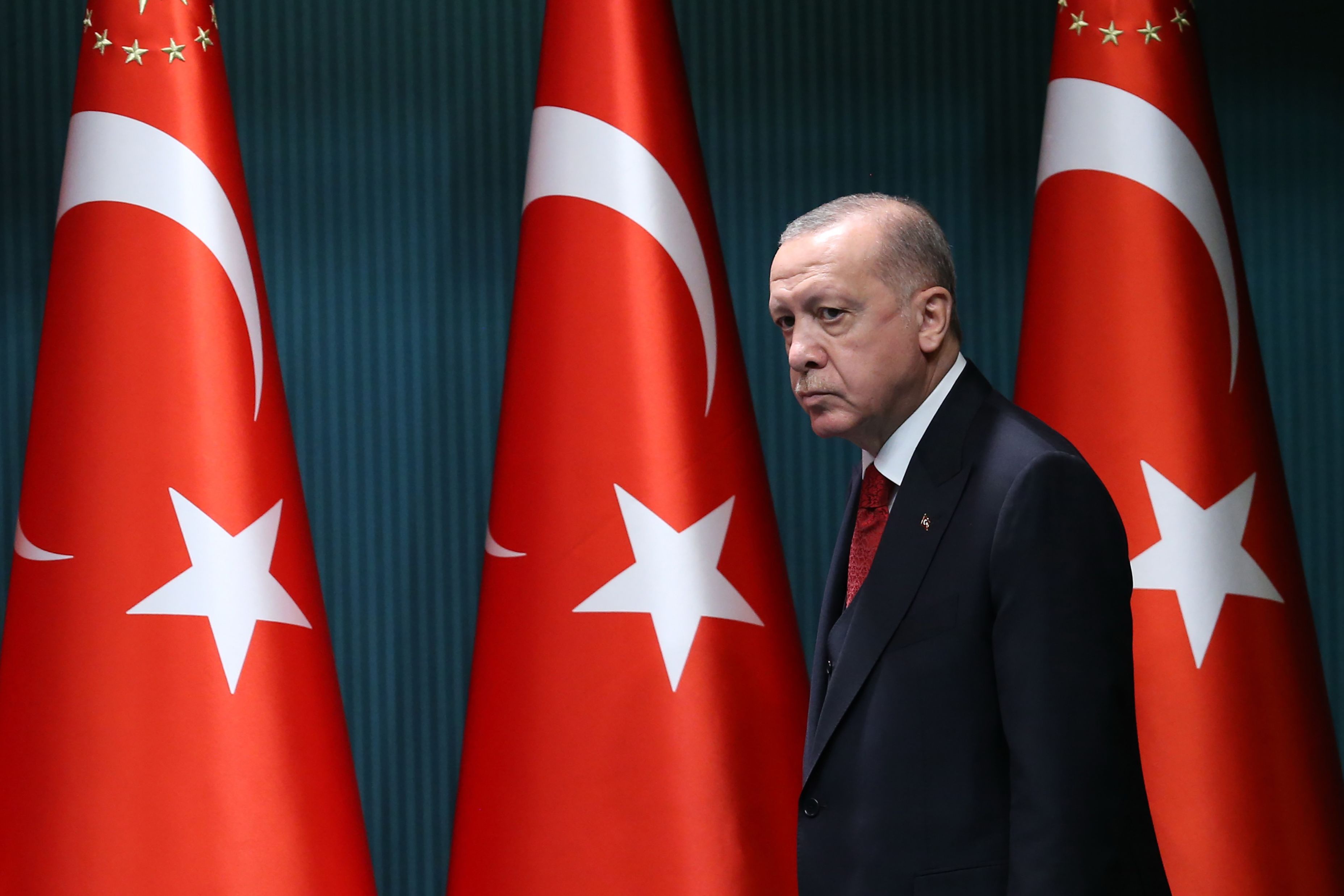
Recep Erdpgan – President of Turkey
Erdogan is often quoted having said, “There is no moderate or immoderate Islam. Islam is Islam and that’s it.”
Secular Turkey
Modern Turkey is a republic with a Muslim majority and a secular constitution. Mustafa Kemal Atatürk founded that state in 1923 on the ruins of the Ottoman Empire. Beginning in 1924, his government abolished the caliphate, put religion under state administration, replaced religious law in public affairs with civil codes, and tried to keep Islam from becoming the organizing principle of political power. The project was a Western-facing nation-state, not a religious empire. Brookings has described the founding program as one that “emphasized secularism in law, modernized education… granted women equal rights,” and adopted the foreign-policy motto “peace at home, peace in the world.”
The reply came quickly. In 1928, four years after Ankara ended the caliphate, Hassan al-Banna founded the Muslim Brotherhood in Egypt. The new movement was born in the vacuum Atatürk had created and treated the restoration of an Islamic political order—and, as a long-term goal, the caliphate itself—as the answer. That current never disappeared. It is the tradition that later reached Turkey through Milli Görüş and, in time, through Erdoğan’s circle.
For more than twenty years, President Recep Tayyip Erdoğan has moved the country in another direction. He was prime minister from 2003 to 2014 and president after 2014. He helped found the Justice and Development Party (AKP) in 2001. The party has Islamic roots and has widened the place of religion in schools, public ritual, and foreign policy. The argument here is not that Turkish citizens should stop being Muslim. It is that Erdoğan has weakened Atatürk’s secular rules for the state and aligned Turkey with political Islam, including networks linked to the Muslim Brotherhood. If he finds a way to run again in 2028 and wins, that shift is likely to harden into the country’s next long phase.
Turkey is not an EU member. It is a candidate and has had a customs union with the EU since 1995. Accession talks that opened in 2005 have been effectively frozen since 2018 because of democratic backsliding and the erosion of the rule of law.
Atatürk’s Republic Being Rewritten by Erdogan
Atatürk’s reforms were a theory of government, not only a change in manners. National identity was defined as Turkish and republican, not Ottoman or pan-Islamic. Religion was to be practiced; it was not to rule.
Erdoğan has not restored the sultanate or the caliphate by name. He has built an Islamist-nationalist mix often called neo-Ottomanism. Religious Imam Hatip schools expanded sharply under the AKP. Curricula were rewritten. Erdoğan made the aim explicit: to “raise a pious generation.” Challenged about that goal, he asked whether anyone expected “a party with a conservative, democratic identity” to “raise an atheist youth.”
Imam Hatip schools are not named for a man. They are vocational religious high schools the republic founded to produce imams and preachers while keeping Islamic education inside the state rather than in independent clerical networks. In Atatürk’s order they were a narrow pipeline. Under Erdoğan they became a mass track. The AKP multiplied the schools, opened them at earlier grades, and treated them as the workshop for the “pious generation.” Students still take secular subjects, but Quran, Arabic, and religious courses sit at the core. The point is political as much as pastoral: a larger share of the next civil service, party cadre, and voting public is formed in classrooms that treat Islam as public formation, not a private inheritance. Educate your children with the nature of governance you prefer, propagandize, shape their minds, and in a few decades change the culture.
In 2020 he completed a more public reversal. A court stripped Hagia Sophia of the museum status Atatürk’s republic had given it, and a presidential decree returned the building to use as a mosque. The New York Times noted that the museum status had, for eighty years, stood as “a symbol of the secularism that was part of the foundation of the modern Turkish state.” The 2017 constitutional overhaul completed the institutional half of the project. Power moved into a strong presidency. Brookings warned at the time that the package would “institutionalize a populist, one-man system” and give the president more independence from checks and balances “than any other Turkish leader since 1946.”
The question is not whether Turkey is a Muslim country. It is whether schools, public ritual, and a near-unchecked presidency are being used together to replace the secular limits Atatürk wrote into the state. That need not produce a caliphate on paper to produce a state in which political Islam sets the terms.
Political Islam and the Muslim Brotherhood
Erdoğan’s political formation is the Milli Görüş (“National View”) movement of Necmettin Erbakan. That tradition shared the Muslim Brotherhood’s core claim: Islam should shape law and government, not merely private worship. The Brotherhood’s motto is “Islam is the solution.” The Foundation for Defense of Democracies has described Milli Görüş as the Brotherhood’s “ideological counterpart” in Turkey and as the movement that “played an integral role in shaping” the AKP.
Necmettin Erbakan (29 October 1926 – 27 February 2011) was Turkey’s first Islamist prime minister and the founder of Millî Görüş, the movement that formed Erdoğan. Trained as an engineer, including doctoral work in Germany, he argued that Turkey could industrialize on its own terms—heavy industry, small business, less dependence on the West—while keeping Islamic values at the center of public life. Millî Görüş was that blend: piety plus a claim to national self-sufficiency, with a preference for Muslim states over the European Community. In June 1996 he became prime minister in coalition. In 1997 he launched the D-8 group of developing Muslim-majority economies—Turkey, Indonesia, Bangladesh, Egypt, Iran, Malaysia, Nigeria, and Pakistan. The secular establishment and the general staff treated his government as a threat to the republic. On 28 February 1997 the National Security Council issued demands that forced him toward resignation; he left office that June. The episode is still called the “postmodern coup.” The Welfare Party was banned in 1998. In 2001 his former lieutenants founded the AKP, and Erdoğan emerged as its leading figure.
After the Egyptian military overthrew Mohamed Morsi in 2013 and Abdel Fattah el-Sisi consolidated power, Brotherhood figures and media operations relocated to Turkey. Research groups have long treated Turkey, with Qatar, as a principal state patron of Brotherhood-linked networks. The most consequential affiliate is Hamas, the Palestinian branch of the Brotherhood.
Erdoğan has treated Hamas as a resistance movement rather than a terrorist organization and has hosted its leaders. That posture did not end after the October 7, 2023 attacks on Israel. The Foundation for Defense of Democracies reported that he hosted Hamas political chief Ismail Haniyeh in Istanbul in the months before Haniyeh was killed in 2024.
Between 2024 and 2026 the U.S. Treasury repeatedly sanctioned Turkey-based charities, money changers, and individuals accused of moving funds to Hamas. In March 2026 it named three Turkish nonprofits—Ghazi Destek Derneği, Hayat Yolu, and the Palestinian White Hands association—as channels of “significant material support to Hamas.” Later that year it designated a Turkey-based exchange house in a third round of such measures. Long War Journal’s conclusion was blunt: Turkish territory “keeps supplying Hamas with fundraising channels and political access that Ankara has not shut down.”
Ankara later eased some tensions with Egypt, Saudi Arabia, and the United Arab Emirates. The Hamas relationship did not end. A government that loosens secular limits at home is more willing to treat Islamist movements abroad as partners.
An Early Warning: The 1997 Poem
The conflict with secular law began before Erdoğan held national office. In December 1997, as mayor of Istanbul, he recited in Siirt, a city is southeastern Turkey, a poem that included the lines, “The mosques are our barracks, the domes our helmets, the minarets our bayonets and the faithful our soldiers.” A court treated the recitation as incitement to religious hatred. In 1998 he received a ten-month sentence, lost the mayoralty, and was banned from politics. He served four months, from 24 March to 27 July 1999, and argued that the poem appeared in state-approved books.
Secular judges of that period heard a call to political Islam. His supporters heard injustice. Both readings explain the later struggle over what the republic is for.
The Kurdish File and the 2028 Gateway for Erdogan
Kurds make up about 15 to 20 percent of Turkey’s population. Since the 1980s the state has fought the Kurdistan Workers’ Party (PKK), listed as terrorist by Turkey, the United States, and the European Union. The war has killed more than 40,000 people. Many pro-Kurdish politicians have been jailed.
In 2025 the PKK said it would disarm and dissolve after a call from its imprisoned founder, Abdullah Öcalan. Fighters held a symbolic weapons-burning ceremony in northern Iraq in July 2025. Reuters called the ceremony “symbolic but significant” and noted that earlier peace efforts had failed. Caution remains reasonable.
Erdoğan faces a legal barrier in 2028. Under current rules he cannot run again unless parliament calls an early election—360 of 600 seats—or the constitution is changed: 360 seats to send an amendment to referendum, 400 to enact it without one. In 2023 the AKP won 268 seats and 35.6 percent of the vote and governed with the nationalist MHP. That alliance does not, by itself, clear 360. Kurdish lawmakers in the DEM Party (pro-Kurdish) could supply the difference.
A genuine settlement with the PKK would be a public good. It could also become the parliamentary path to another Erdoğan term. Both things can be true at once. The concern is not peace. The concern is what that peace is used to purchase: five more years in which the religious-national project is no longer a contested turn, but the settled direction of the state.
The Courts as an Instrument
On 19 March 2025, police detained Istanbul Mayor Ekrem İmamoğlu, then the strongest opposition candidate for 2028. A court jailed him on 23 March pending a corruption trial. Prosecutors also alleged links to a pro-Kurdish electoral alliance. The government said the courts were independent. The opposition called the case political.
The timing is the point. Authorities had already cancelled his university diploma, a move that appeared designed to exploit the constitutional requirement that a president hold a higher-education degree. The arrest came four days before his party’s presidential primary. İmamoğlu wrote from prison that the scene “resembled the capture of a terrorist, not of the elected mayor of Istanbul,” and that Erdoğan, “realizing he cannot defeat me at the ballot box,” had “resorted to other means.”
That pattern is not confined to one mayor. From exile, former NBA player Enes Kanter Freedom, who grew up in Turkey—a critic of Erdoğan and supporter of the Gülen movement—has described a cancelled passport, legal pursuit, and pressure on his family, including the imprisonment of his father. The state’s answer to serious opposition has too often been the file, not the argument.
What 2028 Would Lock In
Erdoğan is not rebuilding the Ottoman Empire of 1923. Erdogan is building a modern Islamist-nationalist state. That state gives Islam a larger public role, recenters Ottoman memory, concentrates power in the presidency, and treats Muslim Brotherhood-linked groups—including Hamas—as partners. Brookings has framed the last century as a contest between “the founding values of the republic” and “a religiously conservative authoritarian” alternative represented by Erdoğan. A further term after 2028 would not invent that alternative. It would give it time to become irreversible in schools, courts, foreign alignments, and the habits of power.
The Warning is Simple.
Turkey can remain Muslim and still keep religion from ruling the state. Atatürk tried to write that separation into the republic. If Erdoğan clears the 2028 hurdle and prevails, Turkey may still hold elections and sit in NATO. It will look less like the secular republic founded in 1923—and more like a state in which political Islam, once the outsider, sets the rules from the palace. The world certainly does not need another Islamic Republic. It has enough to deal with given the likes of Iran and Afghanistan.
Mecca Joint Defense Agreement
On 7 August 2026, Turkey, Saudi Arabia, and Pakistan signed the Mecca Joint Defense Agreement in Mecca. An attack on one is to be treated as an attack on all. The stage is the point. Erdoğan said concluding the pact in Mecca “gave us additional strength and conveyed a separate message to the world.” Atatürk would not have signed such an instrument there. The partners supply what a neo-Ottoman project wants on the map: Saudi wealth and Islamic legitimacy, Pakistani military manpower and a nuclear arsenal, a NATO member as organizer. Officials say no country is named as an enemy. Israel, Greece, and India still read a hedge. The Muslim Brotherhood file is unresolved: Ankara has sheltered that current; Riyadh has treated it as a threat. The pact does not settle that contradiction. I am uncertain Trump was informed prior to publicity given this document, but expressed favorability.
What it gives Erdoğan, if he runs in 2028 and wins, is a foreign-policy monument that matches the domestic turn: Turkey as organizer of a Muslim security circle, with the ceremony held where the 1923 republic would never have held it. He will not need to proclaim a caliphate. He will have a pious generation, a strong presidency, and a Mecca-branded alliance he can try to widen.
The Warning.
This is the warning. Erdoğan is reversing a rare modernizing settlement in the Muslim world: Atatürk’s secular republic. The method is not a restored Ottoman costume. It is schools, courts, a strong presidency, Hamas-adjacent solidarity, and now a defence pledge sworn in Mecca. If that project is locked in after 2028, political Islam sets more of the terms, and the free world is left with another state that treats dogma and personal rule as the successor to a secular constitution. The world does not need another Islamic Republic. Iran and Afghanistan already show what that costs. Turkey does not have to join them. The 1923 republic was built so that it never would.

