By Thomas Balderston
The Slogan
The slogan “Islam is the solution. Allah is our objective; the Quran is our constitution; the Prophet is our leader; Jihad is our way; and death for the sake of Allah is the highest aspiration” is not a private devotion. It is the political platform of the Muslim Brotherhood and a concise statement of a project that treats Islam as a complete system of law, governance, and struggle, not merely a faith of personal conscience. The Muslim Brotherhood is an Islamist movement that seeks to organize political and social life according to its understanding of Islam and Sharia.
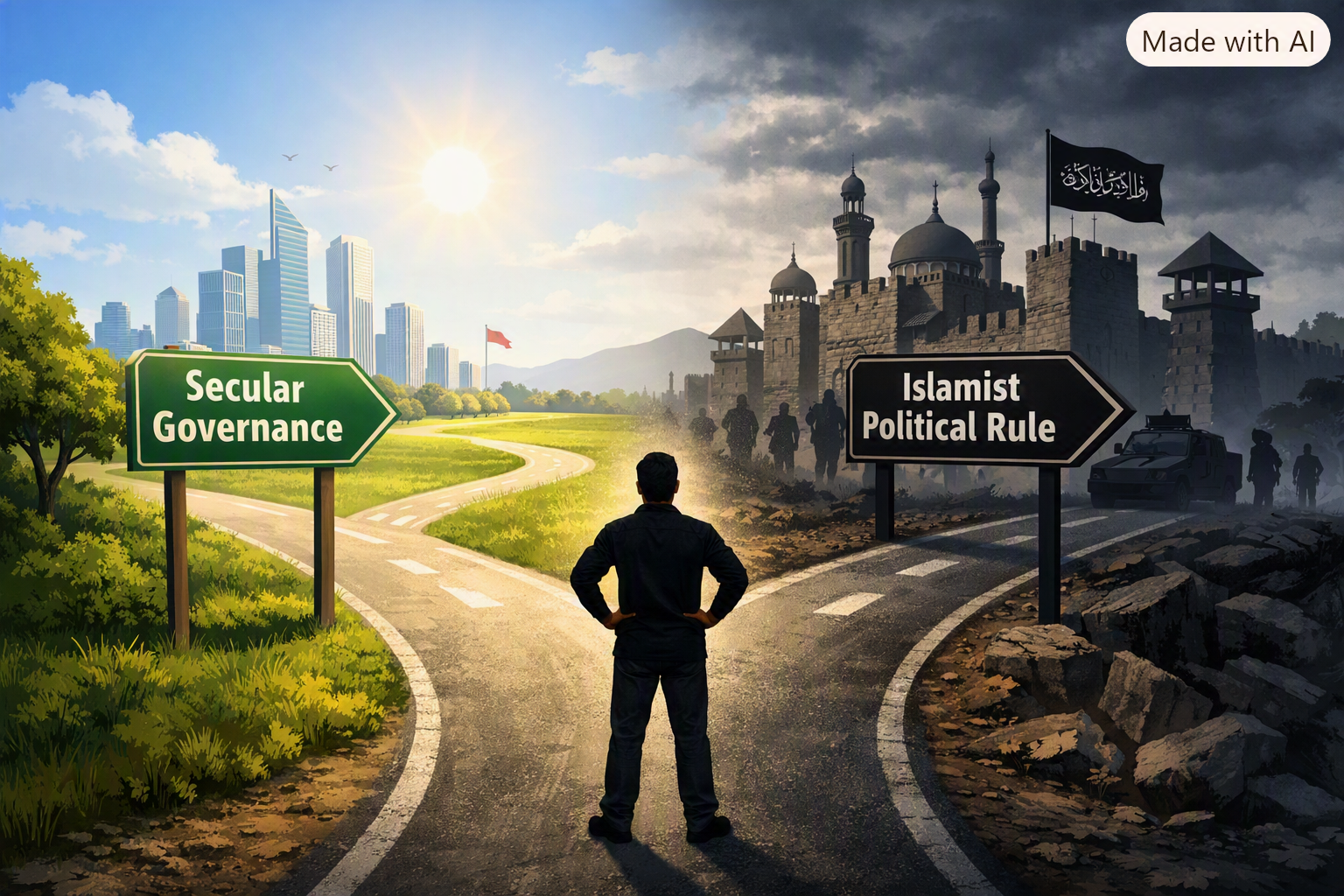
“The Quran is our constitution” rejects the idea that a people may write their own fundamental law. It places religious rule over the needs of citizens. In the Brotherhood’s program, political freedom—the right of the living to legislate independently of revelation—and independence from a sacral order are anathema. Secular governance is forbidden; there is no separation of religion and state. That reading is not an invention of the Brotherhood’s critics. The movement presents Islam as creed, worship, nation, and government together. The same claim has a textual base that Islamists treat as binding: “It is not for a believing man or a believing woman, when Allah and His Messenger have decided a matter, that they should thereafter have any choice about their affair.” Another verse, used for centuries in arguments about judgment and rule, says that those who do not judge by what Allah has revealed are disbelievers. Disputes, in that frame, are to be referred to Allah and the Messenger, not to a secular constitution. Classical political theory followed the same logic: the law precedes the state; the state exists to enforce it. That is why the slogan can speak for a modern party and still sound like a recovery of first principles.
“The Prophet is our leader.” Leadership is modeled on Muhammad—not as a spiritual teacher alone, but as the founder of a polity who combined prophecy, legislation, military command, and rule. The earliest Islamic sources record multiple marriages, the marriage to Aisha at a young age with consummation reported at nine, raids on caravans, and the execution of the men of Banu Qurayza after the siege of Medina, with women and children taken as captives. Those events belong to the traditional record that Islamists treat as exemplary. They describe a seventh-century Arabian war leader as much as a preacher. As the “example” to be followed, the record includes what later ages would call both good and bad. In the 1,400 years since his death, much in the world has changed, especially in human relations and in the treatment of women. Yet the Islamic world still reveres Muhammad, and the framework of the “solution” appears to ignore modernity.
“Jihad is our way” is not limited to inner moral struggle. In the Brotherhood tradition and in groups that share its outlook, it includes the duty to advance Islamic rule: by arms where possible; by settlement, institution-building, political participation, and social pressure where force is not yet available. Mosques, schools, parallel communities, and electoral footholds are instruments. The goal is not coexistence under a secular constitution but the eventual supremacy of Sharia. How the word is applied varies. Hamas treats the clause as a warrant for war. Some Brotherhood chapters emphasize social and political struggle. The destination is the same: Islamic rule.
“Allah is our objective” supplies the sacral cover. The God of the New Testament is presented as knowable in Christ and as offering forgiveness apart from a political order. The Allah of the Quran and the classical legal tradition commands a community that legislates, judges, and expands. The two are not interchangeable. One tradition developed, over centuries, a distinction between church and civil authority. The other did not. The expression Allah Akbar properly interpreted is Allah is Superior, meaning better than God of the Jew and Christian, suggesting they are different.
This is neither a Sunni nor a Shia monopoly. It is a call to restore a caliphate or its functional equivalent. Khomeini applied a version of it in Iran after 1979. The Taliban apply another in Afghanistan. Hamas, which describes itself as a Palestinian wing of the Brotherhood, applies it against Israel. Iran’s proxies follow the same logic. Erdoğan has moved Turkey away from Atatürk’s secular republic toward a more explicitly Islamic politics. Qatar has funded networks that share the outlook. Egypt under Sisi and the Gulf states that banned the Brotherhood understood the threat to their own order.
Where this program gains territory or demographic weight, the pattern is consistent: restrictions on women, religious police or social enforcement of norms, elevated hostility to Jews, and pressure on those who dissent. Critics are labeled Islamophobes. The non-compliant are framed as enemies of God.
The same current appears in Western institutions: Muslim Student Associations on campuses, organizations such as CAIR, and political entry at local and national levels. The MSA was founded in the early 1960s with Brotherhood involvement. CAIR’s founders emerged from the U.S. Brotherhood’s Palestine Committee; the Holy Land Foundation record and later court findings documented that association. CAIR denies present affiliation. The point is not that every campus chapter or press release is a cell. The point is that the political project learned to speak the language of civil rights while keeping the older aim. Alliances with parts of the left—socialists, identity activists, and some in the gay community—rest on a shared opposition to the existing liberal order. Those alliances are not mutual. The ideology described here does not reciprocate liberal views on women, sexuality, or apostasy. Supporting it while expecting it to remain a minority faith is a misreading of its own texts and history.
“Death for the sake of Allah is the highest aspiration.” This may be the most disturbing clause. In political use it makes death in the cause a badge of honor. There is ordinary death, and there is death incurred while striving to build a world “all for Allah.” The promised reward for the second is greater. That changes the cost of politics. A movement that sanctifies dying for the “solution” is not bargaining on the same terms as a party that wants another term in office.
Islam
Islam, in its classical and Islamist forms, is a religio-political system. It supplies ritual, law, identity, and a theory of power. Calling it “only a religion” is the error that allows the political program to advance under the protection granted to conscience. The Brotherhood slogan makes the program explicit. Iran and the Taliban show what it produces when it governs. The question is not whether every Muslim endorses every clause. The question is whether societies, teachers, preachers, politicians, and leaders that value individual rights, equal citizenship, and a constitution written by the living will treat a movement that rejects those things as just another denomination.
If the answer is no, then the response cannot be limited to manners. It requires clear speech about the ideology, limits on the political project, and refusal to grant sacred status to a program that claims the right to rule. I write to make that distinction visible.
Secular Governance
A secular government grants freedom of conscience to all religions, ideologies, and dogmas, yet does not impose the covenants of one on the others. Common law is the application of punishment to shared wrongs such as murder and theft. Questions of honor or guilt may be a family matter, but they cannot be administered in defiance of common law. Majorities in religions, including Islam, tend to be more secular and accepting. That is what defines freedom. The danger appears when an ideological minority gains enough of a foothold to alter common law into religious rule. More dictatorial politicians then impose their power on the people and limit human experience.
Freedom
Free societies survive when citizens understand ideologies that reject their core principles. Adding to that, Islam is NOT the solution.
 Wake Up! Wake Up!