by Thomas Balderston
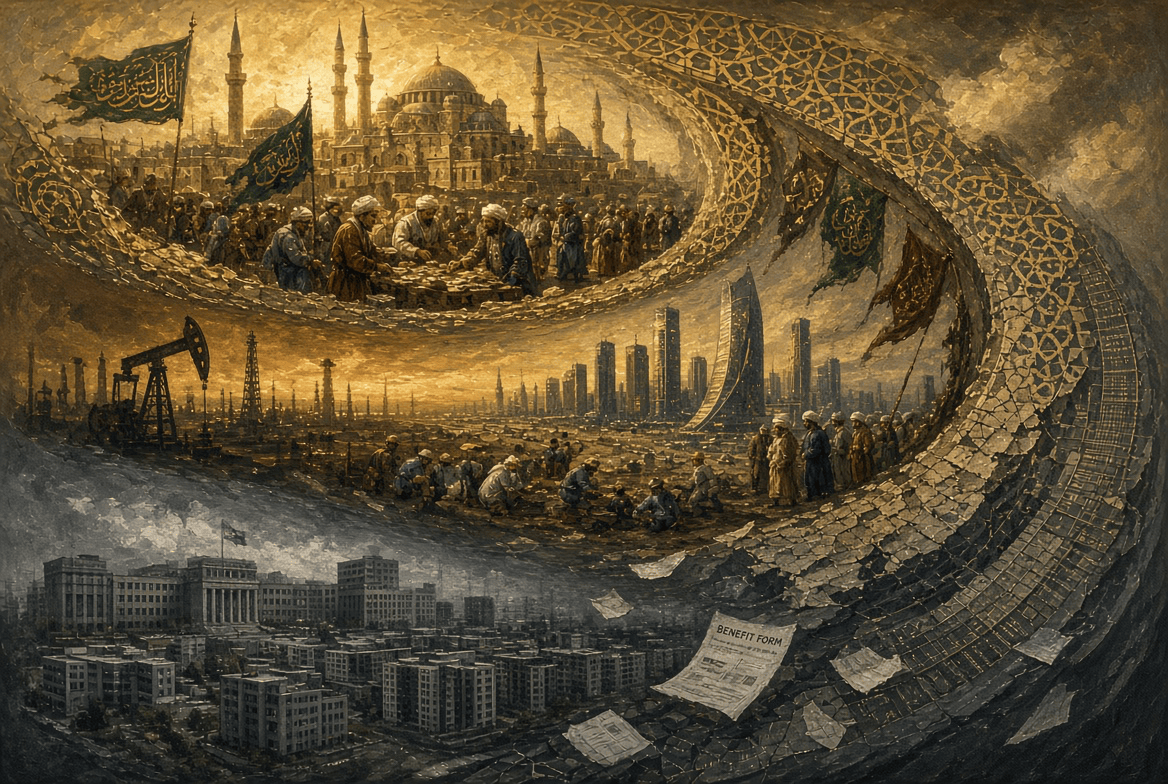
The Spiral of Islam (Image AI Generated by Grok)
Conquest and Jizya
Conquer, tax, convert, repeat—for fourteen centuries this cycle defined one of history’s most successful imperial machines. The machine broke when the conquests stopped, but the design never changed. In 2025, a third of American Muslim households earn less than $30,000. The reason has less to do with America than with a design fourteen centuries old.
Islamic Power
The history of Islamic power rests on two conditions. The first is conquest. The second is jizya.
Muhammad built his following in the early seventh century by breaking the polytheists of Arabia and pushing opposition to the margin. Medina was not an empty camp. There were date groves, a market, and men who farmed and traded. That is not the point. The point is what paid for the rise. After the move from Mecca, he raided caravans and neighbors, especially those who would not accept his rule. Booty filled the treasury. Then he put a tax on those he overcame if they would not join him. That tax was the cash. New ground meant new payers.
After his death in 632 the armies went north, east, and west. In the new lands they were the minority with the swords. They let live the people who were useful and taxed them. The Quran names these subjects dhimmis. It uses dhimma for a pact, and 9:29 is the jizya-and-subordination verse from which the dhimmi system took its name. Jews and Christians—the People of the Book—were to know their place: distinctive dress, obedience, and the poll tax. Convert and the jizya stopped. Stay and you funded the rulers. That bargain is the engine. Conquer and jizya. Conquer and jizya. Other revenue existed—land tax, tithe, customs, later the Ottoman farms and levies—but the political idea was not “we all produce and we all pay.” It was that the people of the Book, and other outsiders, were a resource.
Ottoman Machine – Tax Base Rise and Fall
The Ottomans ran the same machine until it stalled on the edge of Europe. Napoleon in Egypt, the carve-up after the First World War, Atatürk tearing down the sultanate: that was the end of the imperial form. The deeper failure started earlier. This was never built as a workshop. It was built as a harvest of the conquered. As more people became Muslim, the untaxed class grew. As Jews, Christians, and other dhimmis thinned—by conversion, flight, or later nationalism—the easy cash thinned with them. They piled on other taxes and hurt the economy further. They needed new conquest to refresh the base. They were stopped at Vienna. After that, the spiral is visible.
In that respect the pattern is akin to socialism. The socialist distrusts the producer and lives by transferring what the producer makes. That ends when you run out of producers. Why work hard if the take goes to the bureau and the men who do not plant or build? Islamic rule put a religious name on a similar habit. The Muslim was the political master. The dhimmi was the fiscal cow. When the cow herd shrank, the palace still wanted feeding.
So they conquered to widen the taxable base. Jizya sat on Jews and Christians first. When it was not enough they found other ways to squeeze, and the squeeze damaged what was left. Economies went slack. The Ottoman state went slack. A religious rule organized around subjugation was not written to make a country that lives on its own labor. It can borrow prosperity from the people it sits on. It has done that for a long time. It has not shown that it prefers the other life.
Robert Spencer wrote: “The subjugation of the people of the book has indeed been the primary source of income for Islamic polities throughout history, and their fortunes have risen and fallen with the wealth or poverty of the subjugated communities. The best life has never been envisioned as one in which one labors hard and well and then enjoys the fruits of one’s labor. Instead, the ideal has always been to enjoy the fruits of the labor of others.” (The Tragedy of Islam: Failure and Excuses)
The Downward Spiral
Spencer put the thing cleanly. That is the downward spiral. Expand, tax the outsider, convert the outsider, lose the tax, need another war. When the wars stop, you are left with the ideology and a thinner herd. The work of farmers and merchants in Muslim lands does not erase the design. The design was never “build.” It was “take, then call the taking holy.”
The Flaw in the Islamic System
For Turkey after the Ottoman fall and World War I, Atatürk saw the flaws. He embraced the modern nation and realized religious rule was not how a society succeeds. His focus became prosperity for the people. Commerce, manufacture, a productive economy—that was essential. It was the opposite of the nation’s history and required Islam to take a back seat to progress. Had the empire applied that logic it might have survived by developing reliable sources of revenue without dependency on dhimmis. Conquest would no longer be necessary. Nationalism would prevail. All religions were accepted and the burqa was disallowed.
It is unfortunate that Erdoğan has been in the process of the re-Islamization of Turkey. The question is whether the same pattern will repeat: when religious rule is earnestly applied anew, does the productive economy yield to the older design of extraction?
Geological Revenue
Turkey showed what happens when the old design is abandoned. The Gulf states show what happens when the old design is bypassed entirely—not by reform, but by geology.
An act of geology, not piety, created wealth beyond the imagination of every citizen in several Muslim nations. Oil discovered in Iran and Saudi Arabia provided income that did not require toil. Even in the production of oil, at least initially, locals were not used. The British and Americans were contracted to extract the resource. Other countries such as the UAE continue to employ non-Muslim foreigners in many job positions while citizens enjoy their black gold.
These nations do not collect jizya because there is no need. Oil replaced the dhimmi as the external revenue source. The design—living off the labor of others rather than one’s own—stayed intact. The non-Muslim foreigner became the new fiscal resource, just as the dhimmi once was. When oil prices fall, the underlying structure becomes visible: an economy built around extraction, whether of people or of resources.
Welfare As Jizya
Oil states bypassed the spiral by luck. But the design persists, and where the luck or the oil does not exist, the original mechanism reasserts itself. The welfare state has become the unwitting enabler.
In the West, Muslims seeing welfare in free countries as jizya is the contemporary version. They move from poorer countries to modern ones and suddenly receive payments because they are unemployed or live in households with multiple wives and children. Unwed mothers receive welfare. Some such households receive significant sums in cash, food stamps, and other benefits, including healthcare. The male sits back, collects the benefits, does not work, and finds the system fits the mold.
There are no formal dhimmis, yet the producers in the host country—mostly Christians and Jews—are treated as Allah’s provision. Politicians do not change the laws because these people represent votes; the party that supports the programs keeps the votes and keeps office. This has become another form of conquer and collect.
America has become a political and social system that is costly. Of the 1–2% who are Muslim in America, do they receive a disproportionate share of welfare compared with other Americans?
Because a larger fraction of Muslim households fall into the income range that qualifies for SNAP, Medicaid, and related programs—and because a subset of the community consists of low-skilled refugee and family-reunification immigrants—Muslims as a group almost certainly receive a larger share of means-tested welfare than their 1–2% population share. The gap is not uniform: professional-class and East/South Asian Muslims look different from Somali, Afghan, or certain African-American Muslim communities. Direct religion-coded welfare data does not exist, so the inference rests on income, nativity, family size, and origin-country patterns.
ISPU’s American Muslim Poll (2025) found 35% of Muslim households earn $30,000 or less, versus about 20% of the general public. The $100,000+ share is similar to many other groups (~24%). Earlier ISPU and Pew surveys showed similar gaps. Muslims as a group are younger, more likely to be immigrants or children of immigrants, and more likely to have children in the household than the overall population.
Allah’s Unkept Promise
The data shows the gap. The question is why it persists across generations and borders. The answer lies not in the host country, but in the design.
The Qur’an says: “Allah has promised those of you who believe and do good works that he will surely make them succeed on the earth even as he caused those who were before them to succeed, and that he will surely establish for them their religion which he has approved for them, and will give them in exchange safety after their fear.” (24:55)
This promise has not been kept. The believers in Allah have not succeeded on this earth, nor has their failure been disconnected from their religion. Islam is responsible for the economic failure of majority-Muslim states, and for the lowly status of women and non-Muslims within them. (Spencer, The Tragedy of Islam)
No Heaven on Earth for Islam’s Strident Adherents
Wake up to the problems of Islam. Be informed. Realize Islam has never been a solution. It may claim paradise for believers in the afterlife, but it provides nothing like heaven on earth.