In the past at this site, we have documented* how certain mosques function not only as houses of worship but as military training facilities, centers of radicalization for Muslim youth, and hubs for ideological coordination. With thousands of mosques now operating across the United States — and hundreds in cities like New York — a resilient, parallel system is taking shape. It functions like a permanent government without elections, turnover, or democratic accountability. This mosque network provides continuity and cohesion, enabling Islamic clerics and leaders to organize, propagate the faith, and expand influence across communities. Through the mosques, during Friday prayers, imams can encourage protests against the infidels. It is the structural backbone that allows Islam to grow and consolidate power in non-Muslim lands through the Jihad of migration (Hijra), establishing new territories for Allah while building both collective and individual capacity to challenge the host society.
Why is this a concern? As the presence of Islam grows in a new region, these mosque networks provide cohesion and allow adherents to strengthen both their offensive capabilities and their defense. The defense of Islam operates largely through propaganda, accusations of “Islamophobia,” and efforts to gain credibility and unrestricted access. Financial resources come from obligatory charity (Zakat) — portions of which support dawah (propagation), mosque-building, and sometimes political or militant groups — as well as from foreign entities such as Saudi Arabia and Qatar, which have funded mosques and institutions abroad for decades. The ultimate goal is a world entirely for Allah: borderless, global, and achieved one territory at a time. When Muhammad died in 632 CE, there was one Muslim polity in Arabia. In the 1,400 years since, there are now 57 OIC member countries, most with Muslim majorities and varying degrees of Sharia governance. In these nations, mosque and state function as one.
An Example — Iran
Iran before the 1979 Revolution faced pervasive foreign influence. The government was secular on the surface, with Islam as the state religion. Modernization benefited elites and major cities, but the population as a whole felt disconnected. Shah Mohammad Reza Pahlavi, backed by the United States after the 1953 coup that restored Western oil interests, ruled as an authoritarian monarch. His regime grew corrupt, protected by the SAVAK security force, and he exiled Ayatollah Khomeini in the mid-1960s for opposition.
From exile in Paris, Khomeini used Iran’s existing network of mosques to build a powerful propaganda machine — distributing recorded messages and pamphlets. This “mosque machine” undermined the Shah and fueled resistance to foreign influence. The transition in early 1979 was remarkably smooth and largely non-violent. The Shah left for medical treatment; Khomeini returned and assumed religious and political authority. Clerics leveraged the mosque network to coordinate with administrators and form a new government. With ruthless efficiency, Khomeini purged Shah loyalists in the military and politics. The established mosque system prevented chaos and enabled a seamless takeover.
Terrorist infrastructures, Iran an example, have used a system of mosques, Islamic Cultural Centers, charities (non-profit), front companies or shadow entities, proxies, and diaspora to conduct their attacks, providing deniability as to a central source. Weapons, sanctioned goods, oil also, can be shipped using disguised banking systems and companies, the mosque-machine coordinating the efforts. Financiers, smugglers, traffickers and money launderers hide behind the doors and operate in a clandestine fashion alongside criminal factions and cartels.
The Unseen Theocracy
Many Iranians did not anticipate the extreme religious imposition that followed. Though Shiite tradition had historically allowed some separation of religion and state, Khomeini forged a new path. He created the IRGC as a parallel military force to protect the clerical leadership, enforce Sharia, and suppress dissent. The Basij — a volunteer militia of young adults — infiltrated communities as watchdogs, rewarding informants and crushing protests. Mosques were used as recruitment centers and staging areas. Khomeini became Supreme Leader of a total theocracy where religious, political, and authoritarian power merged into one; mosques became command posts in local areas. .
Mosques are more than houses of worship. They operate as a decentralized, resilient network for coordination, propagation, political influence, and — in some cases — militancy. Local, national, and global, they are bound by Islam’s core objective, which scholars, imams, and administrators teach, train, encourage, and advance. Imams and scholars from foreign countries often emigrate to mosques in the free world, as knowledgeable operators and loyalists, to indoctrinate, coordinate and train in the ways of the Islamist. No secular government possesses a comparable ongoing network with such historical depth, coordination, and loyalty.
Implacable Faith: The Global Mosque Network and the End of Moderation
Many mosques function as community centers serving moderate Muslims. However, the most informed, educated, and devout leaders in the hierarchy consistently guide their congregations toward stricter adherence. As Turkey’s President Erdogan stated (paraphrased): “There is no such thing as moderate Islam. Islam is Islam.” Moderate Muslims are often viewed as needing further education — otherwise, under classical Islamic law, they risk being treated as infidels subject to jizya, submission, or charges of apostasy. True fidelity to the ideology prohibits altering the Quran or core tenets. This drive is especially pronounced in Salafi and Wahhabi orientations.
Free world societies have secular governance, separating religion and government, faith and political. Judeo-Christian areas accept secular, non-theocratic, oversight systems. Not so for Islam, as secularism is neutral and suppresses Islam, requiring it live side-by-side with alternatives. Thus assimilation for the Muslim does not work, and so they are reminded with every visit to a mosque or Islamic center and discouraged from becoming too neighborly (unless it advances their cause) as to not become an apostate. Mosque attendance reinforces orthodoxy. Islam cannot survive unless enforced. The enforcers are developed and sent forth from the mosque-machine.
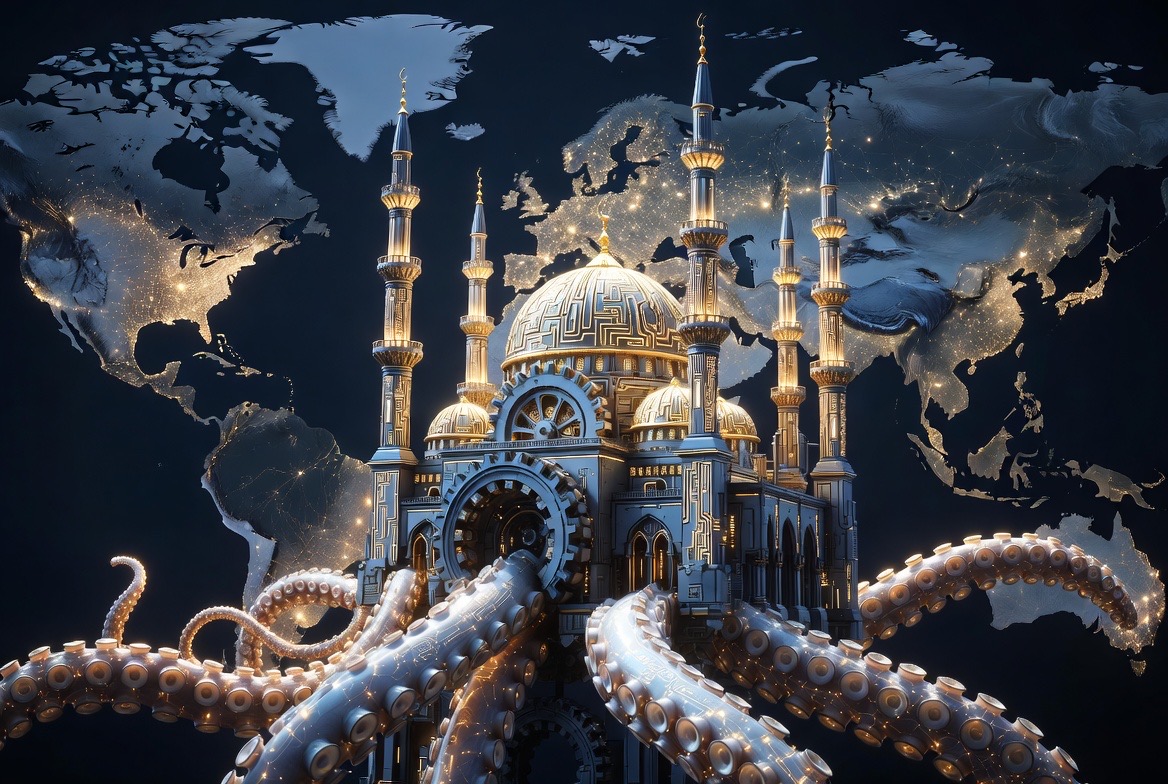
The mosque network functions as the machine of Islam’s political ideology and control — like an octopus whose tentacles span the earth. It positions idealists, politicians, community leaders, and ordinary believers into aligned roles. Indoctrination occurs in mosques and madrassas. Followers, as lemmings, are equipped — and commanded through various forms of jihad — to advance Islam’s footing in their communities and ultimately the world. Mosques interconnect, as components of a transnational web, operating in the shadows, legitimized as worship centers, to aide in the resilient asymmetric system of disruption, causing fear, and providing a defense, to spread Islam and exploit open societies (as the countries in the free world.) Gaps in borders, open borders, enable these networks to make inroads into new territory. Evidence can be seen with no-go zones, Sharia courts and the sound of the adhan. Societies ignoring this pattern risk gradual erosion of their own foundations.
Grace and Peace
By Thomas W. Balderston, Author and Blogger
 Wake Up! Wake Up!