by Thomas Balderston

Dome of The Rock – Temple Grounds
Bully Move
Every bully has a signature move. It is not merely the punch—it is the public display of power, the humiliation performed where the victim’s allies can see it. The Islamist understands this instinctively. Where conquest alone would suffice, he chooses spectacle. Where demolition would erase memory, he prefers conversion.
The pattern is old. The early Arab armies swept through the Middle East, North Africa, and Persia in the seventh and eighth centuries. They found churches. They found synagogues. They found temples older than their own faith. The practical thing would have been to build new mosques across the street, or down the road, or on empty ground. There was plenty of it. Instead they entered the sanctuaries of the conquered, scraped the crosses from the walls, installed a mihrab pointing toward Mecca, and declared the building reborn.
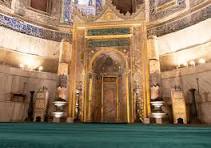
Mihrab at Hagia Sophia
This was not pragmatism. It was theater. The message was written in stone: your gods are finished, your pride is our platform, your holiest place now serves ours.
Insults to be Punished
Islamist movements often treat dissent as an insult to be punished, not a disagreement to be answered.
- Blasphemy and apostasy pressure. In Pakistan, Iran, Afghanistan under the Taliban, and parts of Nigeria, accusation itself can get someone beaten, jailed, or killed. The point is not only doctrine. It is to make everyone watch what happens to the person who stepped out of line.
- Minority and women’s control. Dress codes, guardianship rules, restrictions on churches and temples, and “morality” patrols work as public ranking: who may appear, speak, and move without asking permission.
- Sacred-site politics. Occupying or closing a rival holy place, forbidding Jewish prayer on the Temple Mount platform, or reconverting Hagia Sophia is not mainly about extra prayer space. It is a ranking signal, a tactic.
- Street and diaspora intimidation. Riots after cartoons, threats to teachers, demands that Western cities treat Islamic taboos as public law, and some high-visibility street prayers are dominance theater: your sidewalk, our rules. Jihadist groups are the extreme end of the same logic—terror as a message, not just a military tool.
That is bullying in the ordinary sense: make the weaker party eat the cost of resistance, then call the resistance “provocation.”
Asserting Dominance
The Byzantines felt it first. The great church of Damascus, built to honor John the Baptist, became the Umayyad Mosque. Churches across Egypt and the Levant became mosques. The Zoroastrian fire temples of Persia became Muslim prayer halls. In each case the conquerors could have built fresh. The absence of necessity is what reveals the motive.
The Ottomans refined the practice. After 1453, Constantinople’s Hagia Sophia—engineering marvel of the Byzantine world, architectural expression of Christian civilization for a thousand years—became a mosque. Minarets were affixed to its flanks. Its mosaics were plastered over. The great dome, once lifted in supplication to the Christian Trinity, now echoed with Islamic prayer.
Then came Atatürk. In 1934, the Turkish republic’s founder declared Hagia Sophia a museum. His logic was secular and strategic: the building belonged to world civilization, not to a single faith’s claims. Christian mosaics were uncovered. Muslim carpets were removed. The space became neutral ground, a gesture that the modern Turkish state would not define itself through the humiliation of its predecessor.
But bullies do not forget slights to their dominance, and they do not respect neutral ground. In 2020, Recep Tayyip Erdoğan ordered Hagia Sophia reconverted to a mosque. The carpets returned. The mosaics were covered again. The call to prayer sounded where it had not been heard since the early republic.
What was the practical need? Istanbul has thousands of mosques. Many sit half-empty. None of this was about prayer space. It was about the reassertion of a hierarchy—about reminding the world, and perhaps himself, who was master now. The building was not the point. The point was the message sent by dominating it.
Textbook Example – Jerusalem, The Temple Mount
If Hagia Sophia is the signature case, the Temple Mount in Jerusalem is the textbook.
The Jewish Temple stood there first. Solomon built it. Zerubbabel rebuilt it. Herod expanded it into one of the ancient world’s great sacred complexes. The Romans destroyed it in 70 AD. The Western Wall, a retaining structure, is all that remains—a fragment of Jewish sanctity clinging to the edge of the platform where the Temple once stood.
Centuries later, in the late seventh century, the Umayyad caliph Abd al-Malik constructed the Dome of the Rock and the Al-Aqsa Mosque on that same platform (692 ce). Question: why there?
Jerusalem holds no natural strategic advantage for early Islamic empire beyond what dozens of other conquered cities offered. It was not a capital. It was not a trade hub of unique importance. The Quran mentions Jerusalem not at all by name. The single verse cited—17:1, with its ‘farthest mosque’—does not specify location. Muhammad died in 632. The Dome of the Rock was completed in 691–692. The first written biography linking Muhammad’s Night Journey specifically to that rock in Jerusalem, Ibn Ishaq’s Sirat al-Nabi, appeared around 750—more than a century after the building was finished. The Islamic connection to the city was constructed after the fact, precisely when Umayyad rulers needed to justify their presence atop Judaism’s holiest site.
That story is the Isra and Mi’raj: Muhammad’s Night Journey. On a winged steed called Buraq (a burro), he is said to have traveled from Mecca to the “farthest mosque”—identified by later tradition as Jerusalem—and from there ascended through the heavens, meeting prophets and ultimately approaching the divine presence.
What matters is the placement of the mosque.
The Dome of the Rock sits directly atop the Temple’s traditional location—the Foundation Stone, the holiest point in Jewish sacred geography. It is built to be seen, to dominate, to overshadow the wall below. The golden dome catches the light from across the city. The message is unmissable: what you held most sacred, we now hold; what you mourn, we celebrate. You are subordinate to us.
This is the bully’s signature in its purest form. Building a general mosque in Jerusalem would have satisfied any genuine need for Muslim prayer. Building that specific mosque, in that specific spot, with that specific visual dominance, served a different need entirely.
The Waqf—the Jordanian-administered Islamic trust—controls the Mount today. Jewish prayer there is forbidden. Visitors are monitored. Under the guise of “maintenance,” archaeological evidence of the Temple’s existence has reportedly been removed or destroyed. The erasure operates on two levels: physical and narrative. Remove the artifacts that testify to the prior claim, and the prior claim becomes easier to deny.
Pattern of Repetition
The pattern repeats wherever Islamists have power and a predecessor civilization to supplant.
In India, the Babri Masjid in Ayodhya was built on a site Hindus identified as Ram Janmabhoomi—the birthplace of Lord Ram. Archaeological investigations confirmed the presence of a pre-existing Hindu temple structure beneath the mosque. The 1992 demolition of the mosque and subsequent construction of a Hindu temple represents the reverse move: the colonized reclaiming from the colonizer. But the original offense was the same pattern—build atop the sacred site of the conquered, assert dominance through architecture.
In Iran, Zoroastrian temples became mosques. In Egypt, Coptic churches were converted or built over. In Spain, the Great Mosque of Córdoba was constructed from the materials of a demolished Visigothic church—columns, capitals, altarpieces repurposed as spolia, the spoils of conquest displayed proudly inside the mosque itself.
In each case, the same question arises: why not build across the street? Why not leave the old structure standing as a relic of a prior age, the way Rome absorbed pagan temples or Christian Europe preserved Roman ruins?
The answer is that absorption and preservation acknowledge equality. Conversion denies it. The converted building is not a relic. It is a trophy.
And trophies matter to bullies.
The Psychology of the Move
Non-Muslims often misunderstand the conversion impulse as practical or pious. It is neither, or at least not primarily.
The practical argument—that building materials were scarce, that city centers were crowded—fails on inspection. Early Islamic conquests seized vast territories with abundant stone, timber, and labor. New cities like Baghdad and Cairo were built from nothing. Existing cities had available land. The choice to convert rather than build new was consistently a choice, not a constraint.
The pious argument—that Muslims were reclaiming sites originally dedicated to Allah before corruption by other faiths—serves as rationalization but not explanation. It begs the question why the same logic was not applied equally across all conquered territories, and why the “reclamation” so consistently targeted the most symbolically charged structures rather than the most structurally suitable ones.
What remains is psychological. It’s mine now. The converted mosque is a demonstration of irreversibility. It tells the conquered: not only are you defeated, but your defeat is permanent. Your holy place serves mine now, and serving mine, it testifies against you. You may remember what it was. Everyone who enters will remember what it is.
This is the logic of the bully who takes the smaller child’s lunch not because he is hungry, but because making the smaller child watch him eat it is the point.
It is also the logic of Islamist governance, from the Persian Gulf to European suburbs. The outward markers—dress codes, speech restrictions, architectural dominance—are not side effects of piety. They are mechanisms of boundary maintenance, signals of who commands and who submits.
Hagia Sophia, Revisited
Erdoğan’s reconversion of Hagia Sophia was met with ritual condemnation from UNESCO, the European Union, and various Christian denominations. It changed nothing. The building remains a mosque. The mosaics remain covered. The call to prayer continues.
The West’s response is instructive. Treating the matter as a cultural heritage dispute misses the power dynamic entirely. Erdoğan was not debating curatorial ethics. He was reasserting the hierarchy that Atatürk had temporarily suspended. Hagia Sophia as museum said: we are equals in civilization. Hagia Sophia as mosque says: we are not.
The building itself is the argument. No additional words are necessary.
The Temple Mount, Revisited
In Jerusalem, the situation holds a different tension. Israel controls the city but not the Mount’s interior. The Waqf controls the platform. The arrangement—famously described as “Jordan is the custodian of the Muslim holy places in Jerusalem”—is a political compromise that leaves the original site of Jewish worship under Islamic religious administration.
This is extraordinary if one pauses to consider it. The surviving wall of the Jewish Temple is a site of prayer for Jews. Above it, on the platform where the Temple stood, Jews are forbidden to pray. The prohibition is not Israeli. It is Waqf. Israel enforces it to prevent violence, which tells its own story about who threatens whom.
The message is layered. First: your holiest site is inaccessible to you. Second: our presence on it is non-negotiable. Third: any attempt to alter this arrangement will be met with violence, and we will blame you for provoking it.
This is how bullies operate. The victim’s resistance becomes the ostensible cause of the victimization. The Jewish wish to pray at the wall, or to visit the Mount, is framed as “provocation.” The Muslim control of the Mount is framed as “sensitivity.” The inversion is complete.
Praying in the Streets
A true affront to Christians, Jews and non-Muslims is the act of gatherings of Muslims at prayer times in rows, kneeling, kissing the ground, on major streets. It has been pictured in the UK, in the United States, and in other free world countries. They do not do this in Muslim countries. This is a clear slap in the face to Islamaphobes and all others, demonstrating dominance and the superiority of Islam (in their minds anyway).

AOC and Mamdani at The 911 Memorial Ceremony
On 9/11/2026 NYC’s Muslim Mayor Mamdani, in spite of over 100,000 signatures on a petition and public outcry requesting he not attend the memorial, did so anyway. Called “disrespectful” and “offensive” by one attendee, and without an invitation, the mayor mixed with past Presidents, family members of those that died and Mayor Guiliani. Alongside AOC, the two could be seen laughing during the event. Why did he attend? Because he wants NY to know that Muslims are superior. It is a reflection of the history of Islam, and whether overt or unintended, that is the message sent.

Conclusion: Reading the Stones
The Islamist as bully is visible in conquest, in taxation, in the imposition of dress codes and speech codes. But the architecture is perhaps the clearest text, because it is deliberate, permanent, and public.
A church converted to a mosque is not a reused building. It is a document. It says: we were stronger, we are stronger, and we intend that you know it.
Hagia Sophia says it. The Dome of the Rock says it. Every minaret raised over a former temple says it.
The question for the non-Muslim world is whether it can learn to read these buildings as the statements they are, rather than as neutral heritage sites to be preserved by committees. Preservation assumes the conflict is over. The buildings themselves testify that for the Islamist, the conflict is never over. The dominant position must be maintained, reasserted, and where possible, expanded.
The bully does not want peace. The bully wants the lunch table, the hallway, the playground, your streets—and the permanent, visible knowledge in the victim’s eyes that resistance will cost more than submission.
In stone and dome and minaret, that knowledge is inscribed for anyone willing to read it. Beware, Islam, from its institutional foundations, reinforced by indoctrination and punishment, is an existential threat to human rights, independence and freedom.