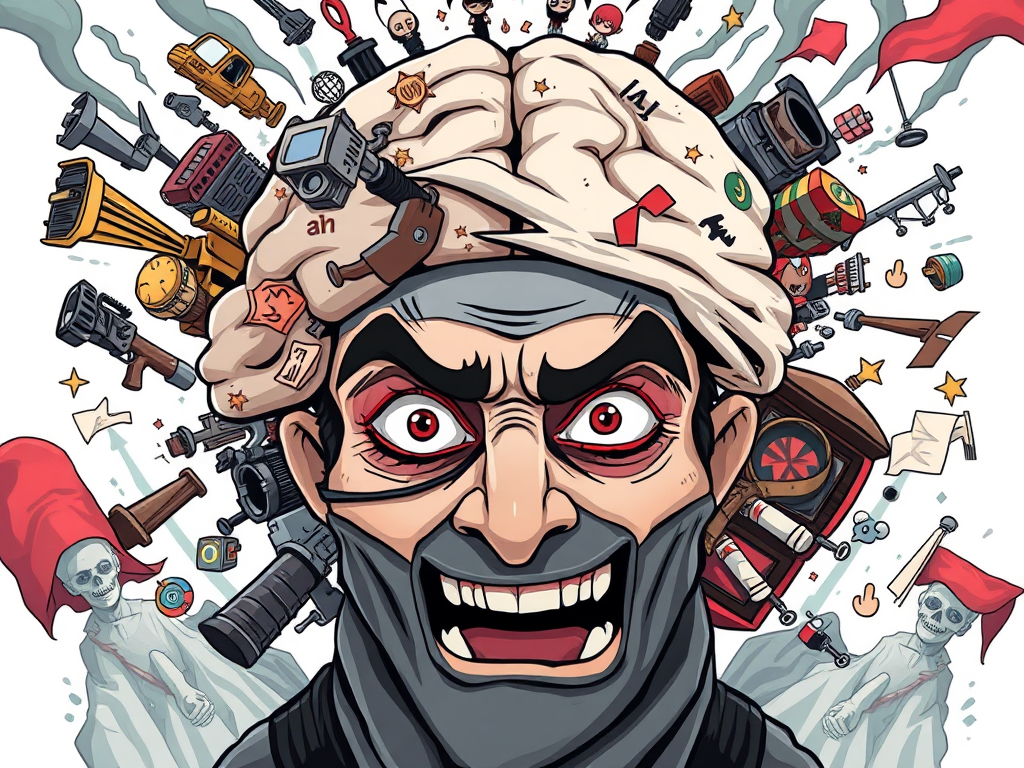
Without Reason
Islamism lacks the depth of wisdom found in many other traditions. I have argued this before. In its most rigid forms, Islamist ideology prioritizes rote memorization of the Quran and selected hadith above broader inquiry, producing followers who often struggle to engage critically with the world beyond their texts. While Islam historically encouraged seeking knowledge, many contemporary Islamist movements narrow that pursuit to serve ideological conformity rather than genuine understanding. The goal, in these circles, appears less about cultivating independent thinkers and more about forging disciplined adherents—loyal soldiers in a cause, obedient to a vision of divine authority that demands submission above all.
Allah is described in Islamic tradition through the 99 Names, many emphasizing power, justice, and mercy. Yet in Islamist interpretations, these attributes often translate into a stern, exacting mastery that leaves little room for the unconditional love many associate with the divine. Male imagery dominates the texts and the societies shaped by them; women are frequently relegated to subordinate roles, separated in worship and daily life, valued primarily as bearers of the next generation of believers.
Islam once flowered spectacularly during its Golden Age (roughly 8th–14th centuries), producing scholars who advanced mathematics, medicine, philosophy, and science. Since then, much of the Muslim world has lagged in intellectual output, and rigid Islamist movements have often resisted modern critical thought, rejecting even moderate Muslims as apostates. My critique here centers on these Islamists—the fundamentalists who insist on literalist, politicized readings of the texts and seek to impose them universally.
Invasive
Islamism spreads like a determined ideology, seeking to reshape societies in its image and eclipse competing visions of human flourishing. Like Jupiter chaining Prometheus, it strives to bind the spirit of free, enlightened modernity—curious, compassionate, and liberated—and keep it imprisoned. Islamists pursue political power through demographic growth, migration, and demands for accommodation. As their communities expand, they press for changes: separate facilities, legal exemptions, cultural dominance. When resistance arises, some feel alienated, interpreting criticism as hatred. Taught their way is uniquely true and destined to prevail, they may respond with accusations of “Islamophobia” and, in extreme cases, justify violence as defense of the faith. Reason often gives way to reflexive grievance.
God versus Allah
Imagine a cosmic story: a supreme God—source of boundless, redemptive love—confronting every lesser conception of divinity that serves fear over freedom. This God declares, “Nothing rooted in coercion and terror can ultimately rule the human soul.” In time, such conceptions fall; beauty and humanity endure. Allah, as understood in Islamist ideology, may command awe and obedience, but the soul’s deepest longing—for unearned grace and intimate love—remains beyond its reach. Judgment belongs to the One who loves without condition.
The Awakening
Transformation begins when individuals trapped in rigid ideology encounter knowledge beyond the approved canon. Islam itself urges seeking knowledge, yet Islamist gatekeepers often restrict it to what reinforces their worldview. What if those restrictions cracked? What if young minds discovered history, philosophy, science, literature—the full record of human striving and creativity? It would be like waking from a long sleep: eyes opening to a world crafted by a loving God who invites understanding, not blind submission.
They would taste intellectual freedom and feel their own dignity rise. They would notice what is missing in the 99 Names as commonly emphasized: the sense of love as unconditional embrace rather than reward for obedience. Deception would fall away. Each person would stand taller—master of their own fate, not a conscript in a perpetual war. Evil, exposed as the lie that fear is holier than love, would wither. Hate and division would recede; kindness and neighborly affection would flourish. Prometheus, unchained, would walk free.
Islamism seeks to divide mankind and is succeeding in many places. Yet intelligence—perhaps accelerated by AI and open access to facts, history, and ideas—can still restore the captive mind, not through force, but through the quiet power of truth and love.
Monsters
Islamists sometimes resemble Mary Shelley’s creature: fearsome on the surface, driven by rejection to lash out, yet capable, beneath the rage, of longing for acceptance. Allah is not called “Father,” and the tradition firmly rejects divine parenthood or offspring. Al-Wadud—“The Loving”—appears among the Names, yet in much Islamist teaching, divine love feels sharply conditional: extended primarily to the obedient, withheld from the wayward, and never resembling the prodigal-son welcome of a father’s heart. Children raised without that sense of unconditional belonging may seek it in the fierce camaraderie of ideology, only to be used as instruments of someone else’s war.
Many Islamists are taught suspicion before affection, submission before inquiry. Their education often prioritizes memorization and obedience over empathy and critical thought. When the wider world recoils from their demands, some cry “Islamophobia” the way other aggrieved groups cry prejudice—sometimes justly, often as a shield against legitimate criticism. Rejected, the most radicalized among them turn vengeful, creating death where they might have sought connection. Frankenstein’s monster was articulate and yearning; he horrified because he was abandoned. Islamists, by contrast, are often deliberately hardened, their compassion narrowed to the in-group, their actions justified by a doctrine that sanctifies struggle.
Hope
In the old myth, Demogorgon overthrew tyrannical Jupiter. A greater reckoning awaits every vision of God that chooses domination over love. Will there be one for the Islamist conception of Allah? Time — and the human hunger for genuine freedom and love — will tell.
There once was an approach taken to Islam, a theological school of thought labelled Mu’talizite (M), that separated the spiritual and the natural. Abandoned by the Sunni culture, this was a more humane approach, referred too as the “rationalist” school. It considered human “reason” as independently able to know basic good and evil. Also that humans make their own choices, and Allah does not predetermine evil. It died out after the mid 9th century in favor of Ash’arite (A) Theology, which was only spiritual in consideration, rejecting rationalism’s limit on divine power. A name closely associated with this dominant understanding today is al-Ghazali. A major difference was the Quran as eternal and uncreated (A), versus the Quran created in time and not eternal (M), and human actions are created by Allah alone, yet held responsible (A). A return to the Mu’talizite school would go a long way in restoring the mind of the Muslim.
by
Thomas W. Balderston
Author and Blogger
 Wake Up! Wake Up!